Application
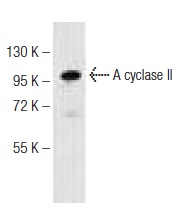
Western blot analysis of A cyclase II expression in Jurkat whole cell lysate.Application
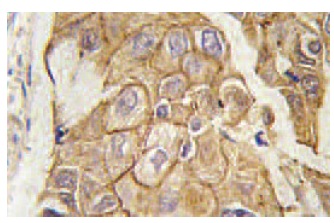
Immunoperoxidase staining of formalin-fixed, paraffin-embedded human lung carcinoma tissue showing cytoplasmic and membrane localization.| Product Name | A cyclase II Antibody (A-21) |
|---|---|
| Antibody Type | Primary Antibodies |
| Antigen Alias | recommended for detection of A cyclase II of human origin by WB, IP, IF, IHC(P) and ELISA |
| Modification Notes | Adenylyl cyclases function to convert ATP to cyclic AMP in response to activation by a variety of hormones, neurotransmitters and other regulatory molecules. Cyclic AMP, in turn, activates several other target molecules to control a broad range of diverse phenomena such as metabolism, gene transcription and memory. Adenylyl cyclases respond to receptor-initiated signals, mediated by the Gs and Gi heterotrimeric G proteins. The binding of an agonist to a Gs coupled receptor catalyzes the exchange of GDP (bound to Ga s) for GTP, the dissociation of GTP-Ga s from Gbg and Ga s-mediated activation of adenylyl cyclase. Adenylyl cyclases of the type II family differ from other subforms in that they are conditionally stimulated by Ga s/bg subunits and regulated by PKC-mediated C-terminal phosphorylation. Both short- and long-term activation of D(2L) dopamine receptors result in a marked degree of sensitization of A cyclase I, II, V and IX, but not A cyclase VIII. The effects on A cyclase I, II and VIII is dependent upon the ability of these A cyclase isoforms to synergistically respond to selective activators in the presence of activated Ga s. |
| Clonality | Polyclonal |
|---|---|
| Isotype | IgG |
| Host Species | Rabbit |
| Tested Applications | WBIPIFIHCELISA |
| WB:1:500~1:2000 IP:1:100~1:500 IF:1:200~1:500 IHC:1:50~1:200 Notes:Optimal dilutions/concentrations should be determined by the researcher. |
|
| Species Reactivity | HumanMouseRat |
| Concentration | 1mg/ml |
| Purification | Affinity purified |
| Alternative Names | recommended for detection of A cyclase II of human origin by WB IP IF IHC(P) and ELISA |
|---|---|
| Tissue Specificity | recommended for detection of A cyclase II of human origin by WB, IP, IF, IHC(P) and ELISA |
| Entrez Gene | 108 |
|---|
Application
Western blot analysis of A cyclase II expression in Jurkat whole cell lysate.
Application
Immunoperoxidase staining of formalin-fixed, paraffin-embedded human lung carcinoma tissue showing cytoplasmic and membrane localization.| Application Notes | WB:1:500~1:2000 IP:1:100~1:500 IF:1:200~1:500 IHC:1:50~1:200 Notes:Optimal dilutions/concentrations should be determined by the researcher. |
|---|
| Form | Liquid |
|---|---|
| Storage Instructions | For short-term storage, store at 4° C. For long-term storage, aliquot and store at -20ºC or below. Avoid multiple freeze-thaw cycles. |
| Storage Buffer | phosphate buffered saline , pH 7.4, 150mM NaCl, 0.02% sodium azide and 50% glycerol. |


