Application
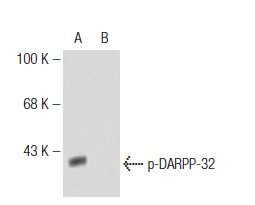
Western blot analysis of DARPP-32 phosphorylation in untreated (A) and lambda protein phosphatase-treated (B) rat caudate nucleus tissue extracts.| Product Name | p-DARPP-32 Antibody (Thr 34) |
|---|---|
| Antibody Type | Primary Antibodies |
| Antigen Alias | recommended for detection of Thr 34 phosphorylated DARPP-32 of mouse, rat and human origin by WB and IP; also reactive with additional species, including bovine and canine |
| Modification | Phosphoralated |
| Modification Notes | Dopaminergic signaling pathways, which are essential for multiple brain functions, are abnormal in several neurological disorders, such as schizophrenia, Parkinson’s disease and drug abuse. DARPP-32 is abundant in neurons that receive dopaminergic input. Activation of PKA and the consequent phosphorylation of DARPP-32 on Thr 34 occurs in response to dopamine acting upon D1-like receptors. Dopamine interaction with D2-like receptors results in the inhibition of PKA activation, the activation of protein phosphatase 2B and the consequent dephosphorylation of DARPP-32 at Thr 34. Phosphorylated DARPP-32 at Thr 34 is a potent inhibitor of PP-1. Phosphorylation of DARPP-32 on Ser 137 by casein kinase inhibits the dephos-phorylation of Thr 34 by calcineurin. Phosphorylation of DARPP-32 on Thr 75 by CdK5 inhibits PKA by a competitive mechanism in vitro. Decreasing the phosphorylaton of DARPP-32 Thr 75 increases the dopamine-induced phosphorylation of PKA substrates. |
| Clonality | Polyclonal |
|---|---|
| Isotype | IgG |
| Host Species | Rabbit |
| Tested Applications | WBIP |
| See 1 citations for p-DARPP-32Antibody (Thr 34): |
|
| Species Reactivity | HumanMouseRat |
| Concentration | 1mg/ml |
| Purification | Affinity purified |
| Alternative Names | recommended for detection of Thr 34 phosphorylated DARPP-32 of mouse rat and human origin by WB and IP also reactive with additional species including bovine and canine |
|---|---|
| Tissue Specificity | recommended for detection of Thr 34 phosphorylated DARPP-32 of mouse, rat and human origin by WB and IP; also reactive with additional species, including bovine and canine |
| Entrez Gene | 84152 |
|---|
Application
Western blot analysis of DARPP-32 phosphorylation in untreated (A) and lambda protein phosphatase-treated (B) rat caudate nucleus tissue extracts.| Application Notes | See 1 citations for p-DARPP-32Antibody (Thr 34): |
|---|
| Form | Liquid |
|---|---|
| Storage Instructions | For short-term storage, store at 4° C. For long-term storage, aliquot and store at -20ºC or below. Avoid multiple freeze-thaw cycles. |
| Storage Buffer | phosphate buffered saline , pH 7.4, 150mM NaCl, 0.02% sodium azide and 50% glycerol. |


