Application
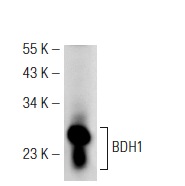
Western blot analysis of BDH1 expression in mouse heart tissue extract.| Product Name | BDH1 Antibody (C-14) |
|---|---|
| Antibody Type | Primary Antibodies |
| Antigen Alias | epitope mapping at the C-terminus of BDH1 of human origin |
| Modification Notes | BDH1 (3-hydroxybutyrate dehydrogenase, type 1), also known as BDH or SDR9C1, is a 343 amino acid protein that localizes to the mitochondrial matrix and belongs to the short-chain dehydrogenases/reductases (SDR) family. Existing as a homotetramer, BDH1 functions to catalyze the NAD+-dependent interconversion of (R)-3-hydroxybutanoate and acetoacetate, a reaction that is allosterically activated by phosphatidylcholine. As both (R)-3-hydroxybutanoate and acetoacetate are two major ketone bodies produced during fatty acid catabolism, BDH1 plays an important role in the metabolic degradation of fatty acids. The gene encoding BDH1 maps to human chromosome 3, which houses over 1,100 genes, including a chemokine receptor (CKR) gene cluster and a variety of human cancer-related gene loci. |
| Clonality | Polyclonal |
|---|---|
| Isotype | IgG |
| Host Species | Rabbit |
| Tested Applications | WBIPIFELISA |
| recommended for detection of BDH1 of mouse, rat and human origin by WB, IP, IF and ELISA also reactive with additional species, including equine, canine, bovine, porcine and avian: |
|
| Species Reactivity | HumanMouseRat |
| Concentration | 1mg/ml |
| Purification | Affinity purified |
| Alternative Names | epitope mapping at the C-terminus of BDH1 of human origin |
|---|---|
| Tissue Specificity | epitope mapping at the C-terminus of BDH1 of human origin |
| Entrez Gene | 622 |
|---|
Application
Western blot analysis of BDH1 expression in mouse heart tissue extract.| Application Notes | recommended for detection of BDH1 of mouse, rat and human origin by WB, IP, IF and ELISA also reactive with additional species, including equine, canine, bovine, porcine and avian: |
|---|
| Form | Liquid |
|---|---|
| Storage Instructions | For short-term storage, store at 4° C. For long-term storage, aliquot and store at -20ºC or below. Avoid multiple freeze-thaw cycles. |
| Storage Buffer | phosphate buffered saline , pH 7.4, 150mM NaCl, 0.02% sodium azide and 50% glycerol. |


