Application
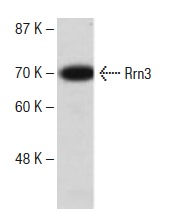
Western blot analysis of Rrn3 expression in Jurkat whole cell lysate.| Product Name | Rrn3 Antibody (Y-23) |
|---|---|
| Antibody Type | Primary Antibodies |
| Antigen Alias | recommended for detection of Rrn3 of human origin by WB, IP and ELISA |
| Modification Notes | In eukaryotes, ribosomal RNA genes are transcribed by RNA polymerase (pol I). In Saccharomyces cerevisiae, transcription of rRNA genes requires at least three transcription factors, which include the two multisubunit factors Core factor and UAF that function in the assembly of the preinitiation complex. The third factor, Rrn3, functions as a single subunit and is not required for the preinitiation complex assembly. Unlike other pol I transcription factors, Rrn3 is functionally conserved between yeast and mammals as an rRNA gene transcription regulator. Human Rrn3 is 21% homologous to the yeast Rrn3 protein and is a member of a conserved gene family spanning the fungi, plant and animal kingdoms. hRrn3 is highly expressed in the lung, retina, thymus, and prostate. Rrn3 may be identical to the transcription factor TIF-IA, since both TIF-IA and Rrn3 associate with pol I and their activities are growth rate dependent. |
| Clonality | Polyclonal |
|---|---|
| Isotype | IgG |
| Host Species | Rabbit |
| Tested Applications | WBIPELISA |
| WB:1:500~1:2000 IP:1:100~1:500 Notes:Optimal dilutions/concentrations should be determined by the researcher. |
|
| Species Reactivity | HumanMouseRat |
| Concentration | 1mg/ml |
| Purification | Affinity purified |
| Alternative Names | recommended for detection of Rrn3 of human origin by WB IP and ELISA |
|---|---|
| Tissue Specificity | recommended for detection of Rrn3 of human origin by WB, IP and ELISA |
| Entrez Gene | 54700 |
|---|
Application
Western blot analysis of Rrn3 expression in Jurkat whole cell lysate.| Application Notes | WB:1:500~1:2000 IP:1:100~1:500 Notes:Optimal dilutions/concentrations should be determined by the researcher. |
|---|
| Form | Liquid |
|---|---|
| Storage Instructions | For short-term storage, store at 4° C. For long-term storage, aliquot and store at -20ºC or below. Avoid multiple freeze-thaw cycles. |
| Storage Buffer | phosphate buffered saline , pH 7.4, 150mM NaCl, 0.02% sodium azide and 50% glycerol. |


