Application
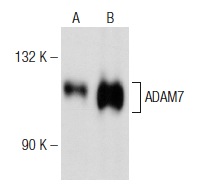
Western blot analysis of ADAM7 expression in rat epididymis (A) and mouse epididymis (B) tissue extracts.| Product Name | ADAM7 Antibody (E-22) |
|---|---|
| Antibody Type | Primary Antibodies |
| Antigen Alias | recommended for detection of ADAM7 of mouse, rat and human origin by WB, IP and ELISA |
| Modification Notes | The ADAM (a disintegrin and metalloprotease) protein family, which includes over 30 membrane-anchored, glycosylated, Zn2+ dependent proteases, plays a role in cell-cell and cell-matrix interface related processes, including fertilization, muscle fusion, secretion of TNFå (tumor necrosis factor å), and modulation of the neurogenic function of Notch and Delta (1–3). The ADAM proteins possess a signal-domain, a pro-domain, a metalloprotease domain, a disintegrin domain (Integrin ligand), a cysteine-rich region, an epidermal growth factor-like domain, a transmembrane domain and a cytoplasmic tail (1–3). ADAMs are expressed in a wide range of mammalian tissues and several are abundantly expressed in the male reproductive tract (3). ADAM7, also designated GP-83, binds wheat germ agglutinin (WGA), and is synthesized as a protein and secreted by corpus and cauda epididymus (4,5). ADAM7 conjugates to spermatozoa during their transit in human epididymus, and may be involved in sperm maturation (6,7). |
| Clonality | Polyclonal |
|---|---|
| Isotype | IgG |
| Host Species | Rabbit |
| Tested Applications | WBIPELISA |
| WB:1:500~1:2000 IP:1:100~1:500 Notes:Optimal dilutions/concentrations should be determined by the researcher. |
|
| Species Reactivity | HumanMouseRat |
| Concentration | 1mg/ml |
| Purification | Affinity purified |
| Alternative Names | recommended for detection of ADAM7 of mouse rat and human origin by WB IP and ELISA |
|---|---|
| Tissue Specificity | recommended for detection of ADAM7 of mouse, rat and human origin by WB, IP and ELISA |
| Entrez Gene | 8756 |
|---|
Application
Western blot analysis of ADAM7 expression in rat epididymis (A) and mouse epididymis (B) tissue extracts.| Application Notes | WB:1:500~1:2000 IP:1:100~1:500 Notes:Optimal dilutions/concentrations should be determined by the researcher. |
|---|
| Form | Liquid |
|---|---|
| Storage Instructions | For short-term storage, store at 4° C. For long-term storage, aliquot and store at -20ºC or below. Avoid multiple freeze-thaw cycles. |
| Storage Buffer | phosphate buffered saline , pH 7.4, 150mM NaCl, 0.02% sodium azide and 50% glycerol. |


