Application
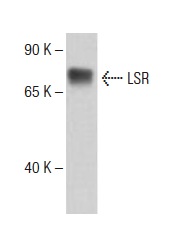
Western blot analysis of LSR expression in human fetal liver tissue extract.| Product Name | LSR Antibody (X-25) |
|---|---|
| Antibody Type | Primary Antibodies |
| Antigen Alias | recommended for detection of LSR of mouse, rat and human origin by WB, IP and ELISA; also reactive with additional species, including canine |
| Modification Notes | LSR (lipolysis stimulated lipoprotein receptor), also known as ILDR3 or LISCH7, is a 649 amino acid single-pass membrane protein that contains one immunoglobulin-like domain and localizes to the cell membrane. Existing as a homotrimer or a homotetramer, LSR is thought to play a role in the clearing of triglyceride-rich lipoproteins from blood, specifically via binding to low density lipoproteins (LDLs) and very low density lipoproteins (VLDLs) and facilitating their uptake into cells. Overexpression of LSR may be associated with increased colon tumor growth, suggesting an involvement for LSR in tumor formation and metastasis. Multiple isoforms of LSR exist due to alternative splicing events. The gene encoding LSR maps to human chromosome 19, which consists of over 63 million bases, houses approximately 1,400 genes and is recognized for having the greatest gene density of the human chromosomes. |
| Clonality | Polyclonal |
|---|---|
| Isotype | IgG |
| Host Species | Rabbit |
| Tested Applications | WBIPELISA |
| See 2 citations for LSRAntibody (X-25): |
|
| Species Reactivity | HumanMouseRat |
| Concentration | 1mg/ml |
| Purification | Affinity purified |
| Alternative Names | recommended for detection of LSR of mouse rat and human origin by WB IP and ELISA also reactive with additional species including canine |
|---|---|
| Tissue Specificity | recommended for detection of LSR of mouse, rat and human origin by WB, IP and ELISA; also reactive with additional species, including canine |
| Entrez Gene | 51599 |
|---|
Application
Western blot analysis of LSR expression in human fetal liver tissue extract.| Application Notes | See 2 citations for LSRAntibody (X-25): |
|---|
| Form | Liquid |
|---|---|
| Storage Instructions | For short-term storage, store at 4° C. For long-term storage, aliquot and store at -20ºC or below. Avoid multiple freeze-thaw cycles. |
| Storage Buffer | phosphate buffered saline , pH 7.4, 150mM NaCl, 0.02% sodium azide and 50% glycerol. |


