Application
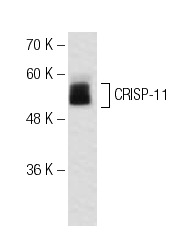
Western blot analysis of CRISP-11 expression in Jurkat whole cell lysate.| Product Name | CRISP-11 Antibody (F-24) |
|---|---|
| Antibody Type | Primary Antibodies |
| Modification Notes | Cysteine-rich secretory proteins (CRISPs) represent a family of evolutionarily conserved proteins that may play a role in the innate immune system and are transcriptionally regulated by androgens in several tissues. CRISP proteins are highly expressed in the mammalian reproductive tract and in the venom secretory ducts of some reptiles. CRISP-11 (cysteine-rich secretory protein 11), also known as cysteine-rich secretory protein LCCL domain-containing 2 (CRISPLD2 or LCRISP2), is a 497 amino acid protein containing 2 LCCL domains, which are thought to function as autonomous folding domains used to construct modular proteins through exon shuffling. Serum concentrations of CRISP-11 have been shown to be an indicator of a patient’s exposure to lipopolysaccahride (LPS), the immunostimulatory component of Gram-negative bacteria, and can determine one’s sensitivity to it. |
| Clonality | Polyclonal |
|---|---|
| Isotype | IgG |
| Host Species | Rabbit |
| Tested Applications | WBIPELISA |
| Species Reactivity | HumanMouseRat |
| Concentration | 1mg/ml |
| Purification | Affinity purified |
| Alternative Names | recommended for detection of CRISP-11 of human origin LCRISP2 of mouse origin and the corresponding rat homolog by WB IP and ELISA |
|---|---|
| Tissue Specificity | recommended for detection of CRISP-11 of human origin, LCRISP2 of mouse origin and the corresponding rat homolog by WB, IP and ELISA |
| Entrez Gene | 83716 |
|---|
Application
Western blot analysis of CRISP-11 expression in Jurkat whole cell lysate.| Form | Liquid |
|---|---|
| Storage Instructions | For short-term storage, store at 4° C. For long-term storage, aliquot and store at -20ºC or below. Avoid multiple freeze-thaw cycles. |
| Storage Buffer | phosphate buffered saline , pH 7.4, 150mM NaCl, 0.02% sodium azide and 50% glycerol. |


