Application
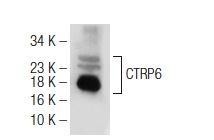
Western blot analysis of CTRP6 expression in mouse eye tissue extract.| Product Name | CTRP6 Antibody (M-48) |
|---|---|
| Antibody Type | Primary Antibodies |
| Modification Notes | Members of the CTRP (complement C1q tumor necrosis factor-related protein) family are structurally related, although functionally diverse. CTRPs share TNF å–like globular domains and N-terminal glycine-X-Y repeats and also tend to form trimers that have the ability to congregate into higher order structures. Functions of this protein family range from immune homeostasis to structural and extracelluar matrix-related roles. CTRP6 (complement C1q tumor necrosis factor-related protein 6) is a 259 amino acid secreted glycoprotein consisting of an N-terminal signal peptide sequence followed by a collagen-like domain and a C-terminal globular domain. Predominantly expressed in eye and placenta, CTRP6 is also upregulated in obese mice. Along with CTRP1, CTRP2, CTRP3 and CTRP5, CTRP6 circulates in the blood and is thought to function as an endocrine hormone. There are three isoforms of CTRP6 that are produced as a result of alternative splicing events. |
| Clonality | Polyclonal |
|---|---|
| Isotype | IgG |
| Host Species | Rabbit |
| Tested Applications | WBIPIFELISA |
| recommended for detection of CTRP6 of mouse and rat origin by WB, IP, IF and ELISA | |
| Species Reactivity | HumanMouseRat |
| Concentration | 1mg/ml |
| Purification | Affinity purified |
| Alternative Names | epitope corresponding to amino acids 87-134 mapping within an internal region of CTRP6 of mouse origin |
|---|---|
| Tissue Specificity | epitope corresponding to amino acids 87-134 mapping within an internal region of CTRP6 of mouse origin |
| Entrez Gene | 72709 |
|---|
Application
Western blot analysis of CTRP6 expression in mouse eye tissue extract.| Application Notes | recommended for detection of CTRP6 of mouse and rat origin by WB, IP, IF and ELISA |
|---|
| Form | Liquid |
|---|---|
| Storage Instructions | For short-term storage, store at 4° C. For long-term storage, aliquot and store at -20ºC or below. Avoid multiple freeze-thaw cycles. |
| Storage Buffer | phosphate buffered saline , pH 7.4, 150mM NaCl, 0.02% sodium azide and 50% glycerol. |


