Application
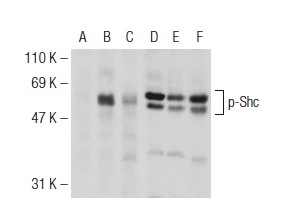
Antibodies tested include p-Shc (Tyr 239): (A,B,C) and Shc (H-108): (D,E,F).Application
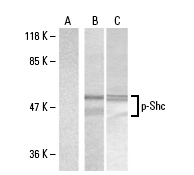
Western blot analysis of phosphorylated Shc expression in untreated (A) Insulin-treated (B) and EGF-treated (C) 293 whole cell lysates.| Product Name | p-Shc Antibody (Tyr 239) |
|---|---|
| Antibody Type | Primary Antibodies |
| Antigen Alias | epitope corresponding to phosphorylated Tyr 239 of Shc of human origin |
| Modification | Phosphoralated |
| Modification Notes | The Shc gene encodes three widely expressed proteins which act as substrates for receptors and tyrosine kinases in signal transduction pathways. Growth factor receptors with tyrosine kinase activity phosphorylate and thus modulate the function of Shc. Specifically, the tyrosine phosphorylation of Shc residues 239/240 and 317 stimulates activation of Ras/MAPK via recruitment of the Grb2-Sos complex, with Shc binding Grb2. These residues are present in all Shc isoforms. In vitro, tyrosine residues 239/240 are phosphorylated by the tyrosine kinase Src, while stimulation of hematopoietic cells with interleukin 3 (IL-3) results in Shc phosphorylation, primarily on residues Tyr 239 and Tyr 317. Similarly, insulin and EGF stimulate the phosphorylation of Shc and the subsequent binding of Shc and Grb2. Shc has a role in insulin-induced mitogenesis by competing with IRS to bind to the insulin receptor. The human Shc gene maps to chromosome 1q21.3. |
| Clonality | Polyclonal |
|---|---|
| Isotype | IgG |
| Host Species | Rabbit |
| Tested Applications | WBIP |
| recommended for detection of Tyr 239 phosphorylated Shc of mouse and human origin by WB and IP: |
|
| Species Reactivity | HumanMouseRat |
| Concentration | 1mg/ml |
| Purification | Affinity purified |
| Alternative Names | epitope corresponding to phosphorylated Tyr 239 of Shc of human origin |
|---|---|
| Tissue Specificity | epitope corresponding to phosphorylated Tyr 239 of Shc of human origin |
| Entrez Gene | 6464 |
|---|
Application
Antibodies tested include p-Shc (Tyr 239): (A,B,C) and Shc (H-108): (D,E,F).
Application
Western blot analysis of phosphorylated Shc expression in untreated (A) Insulin-treated (B) and EGF-treated (C) 293 whole cell lysates.| Application Notes | recommended for detection of Tyr 239 phosphorylated Shc of mouse and human origin by WB and IP: |
|---|
| Form | Liquid |
|---|---|
| Storage Instructions | For short-term storage, store at 4° C. For long-term storage, aliquot and store at -20ºC or below. Avoid multiple freeze-thaw cycles. |
| Storage Buffer | phosphate buffered saline , pH 7.4, 150mM NaCl, 0.02% sodium azide and 50% glycerol. |


