Application
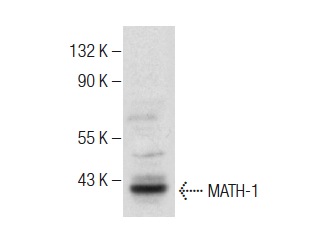
Western blot analysis of MATH-1 expression in mouse brain tissue extract.Application
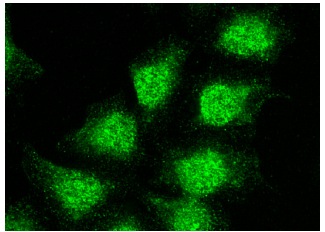
Immunofluorescence staining of methanol-fixed HeLa cells showing nuclear localization.| Product Name | MATH-1 Antibody (M-156) |
|---|---|
| Antibody Type | Primary Antibodies |
| Antigen Alias | epitope corresponding to amino acids 1-156 mapping at the N-terminus of MATH-1 of mouse origin |
| Modification Notes | The Drosophila atonal gene produces a protein with basic helix loop helix (bHLH) domains that plays an essential role in the development of the Drosophila nervous system. Mammalian atonal homolog 1 (MATH-1) is a helix-loop-helix (HLH) transcription factor that is structurally homologous to the product of the Drosophila proneural gene atonal. MATH-1, so known as Atoh1, Ath1 or HATH-1, is a 351 amino acid protein with an atonal-related basic HLH domain. In mice, expression of MATH-1 takes place by embryonic day 9.5 and initially localizes to the cranial ganglions and the dorsal part of the central nervous system. Prominent expression of MATH-1 is in the dorsal part of the central nervous system but becomes restricted to the external granular layer of the cerebellum by day 18 and is undetectable in the adult nervous system. It is suggested that MATH-1 may play a role in the differentiation of subsets of neural cells by activating E box-dependent transcription. |
| Clonality | Polyclonal |
|---|---|
| Isotype | IgG |
| Host Species | Rabbit |
| Tested Applications | WBIPIFELISA |
| recommended for detection of MATH-1 of mouse, rat and human origin by WB, IP, IF and ELISA also reactive with additional species, including canine, bovine and porcine: |
|
| Species Reactivity | HumanMouseRat |
| Concentration | 1mg/ml |
| Purification | Affinity purified |
| Alternative Names | epitope corresponding to amino acids 1-156 mapping at the N-terminus of MATH-1 of mouse origin |
|---|---|
| Tissue Specificity | epitope corresponding to amino acids 1-156 mapping at the N-terminus of MATH-1 of mouse origin |
Application
Western blot analysis of MATH-1 expression in mouse brain tissue extract.
Application
Immunofluorescence staining of methanol-fixed HeLa cells showing nuclear localization.| Application Notes | recommended for detection of MATH-1 of mouse, rat and human origin by WB, IP, IF and ELISA also reactive with additional species, including canine, bovine and porcine: |
|---|
| Form | Liquid |
|---|---|
| Storage Instructions | For short-term storage, store at 4° C. For long-term storage, aliquot and store at -20ºC or below. Avoid multiple freeze-thaw cycles. |
| Storage Buffer | phosphate buffered saline , pH 7.4, 150mM NaCl, 0.02% sodium azide and 50% glycerol. |


