Application
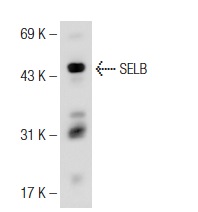
Western blot analysis of SELB expression in mouse brain tissue extract.| Product Name | SELB Antibody (H-240) |
|---|---|
| Antibody Type | Primary Antibodies |
| Antigen Alias | epitope corresponding to amino acids 211-450 mapping within an internal region of SELB of human origin |
| Modification Notes | SELB (selenocysteine-specific elongation factor), also known as EEFSEC (eukaryotic elongation factor, selenocysteine-tRNA-specific) or EFSEC, is a 596 amino acid protein that localizes to both the nucleus and the cytoplasm and belongs to the GTP-binding elongation factor family. Functioning as a translation factor, SELB binds GTP and GDP and is necessary for the incorporation of selenocysteine into target proteins. The gene encoding SELB maps to human chromosome 3, which houses over 1,100 genes, including a chemokine receptor (CKR) gene cluster and a variety of human cancer-related gene loci. Key tumor suppressing genes on chromosome 3 include those that encode the apoptosis mediator RASSF1, the cell migration regulator HYAL1 and the angiogenesis suppressor SEMA3B. Marfan Syndrome, porphyria, von Hippel-Lindau syndrome, osteogenesis imperfecta and Charcot-Marie-Tooth Disease are a few of the numerous genetic diseases associated with chromosome 3. |
| Clonality | Polyclonal |
|---|---|
| Isotype | IgG |
| Host Species | Rabbit |
| Tested Applications | WBIPIFELISA |
| recommended for detection of SELB of mouse, rat and human origin by WB, IP, IF and ELISA also reactive with additional species, including equine, canine, bovine and porcine: |
|
| Species Reactivity | HumanMouseRat |
| Concentration | 1mg/ml |
| Purification | Affinity purified |
| Alternative Names | epitope corresponding to amino acids 211-450 mapping within an internal region of SELB of human origin |
|---|---|
| Tissue Specificity | epitope corresponding to amino acids 211-450 mapping within an internal region of SELB of human origin |
| Entrez Gene | 60678 |
|---|
Application
Western blot analysis of SELB expression in mouse brain tissue extract.| Application Notes | recommended for detection of SELB of mouse, rat and human origin by WB, IP, IF and ELISA also reactive with additional species, including equine, canine, bovine and porcine: |
|---|
| Form | Liquid |
|---|---|
| Storage Instructions | For short-term storage, store at 4° C. For long-term storage, aliquot and store at -20ºC or below. Avoid multiple freeze-thaw cycles. |
| Storage Buffer | phosphate buffered saline , pH 7.4, 150mM NaCl, 0.02% sodium azide and 50% glycerol. |


