Application
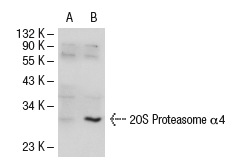
Western blot analysis of 20S Proteasome α4 expression in non-transfected: (A) and human 20S Proteasome α4 transfected: (B) 293T whole cell lysates.| Product Name | 20S Proteasome α4 Antibody (H-128) |
|---|---|
| Antibody Type | Primary Antibodies |
| Antigen Alias | epitope corresponding to amino acids 1-128 mapping at the N-terminus of 20S Proteasome α4 of human origin |
| Modification Notes | The proteasome represents a large protein complex that exists inside all eukaryotes and archaea, and in some bacteria. The main function of proteasomes is to degrade unnecessary or damaged proteins by proteolysis. The most common form of the proteasome, known as the 26S Proteasome, contains one 20S Proteasome core particle structure and two 19S regulatory caps. The 20S Proteasome core is hollow and forms an enclosed cavity, where proteins are degraded, as well as openings at the two ends to allow the target protein to enter. The 20S Proteasome core particle contains many subunits, depending on the organism. All of the subunits fall into one of two types: å subunits, which are structural, serve as docking domains for the regulatory particles and exterior gates blocking unregulated access to the interior cavity; or ∫ subunits, which are predominantly catalytic. The outer two rings in the proteasome consist of seven å subunits each, and the inner two rings each consist of seven ∫ subunits. |
| Clonality | Polyclonal |
|---|---|
| Isotype | IgG |
| Host Species | Rabbit |
| Tested Applications | WBIPIFELISA |
| recommended for detection of 20S Proteasome α4 of mouse, rat and human origin by WB, IP, IF and ELISA also reactive with additional species, including canine, bovine, porcine and avian: |
|
| Species Reactivity | HumanMouseRat |
| Concentration | 1mg/ml |
| Purification | Affinity purified |
| Alternative Names | epitope corresponding to amino acids 1-128 mapping at the N-terminus of 20S Proteasome &alpha 4 of human origin |
|---|---|
| Tissue Specificity | epitope corresponding to amino acids 1-128 mapping at the N-terminus of 20S Proteasome α4 of human origin |
| Entrez Gene | 5685 |
|---|
Application
Western blot analysis of 20S Proteasome α4 expression in non-transfected: (A) and human 20S Proteasome α4 transfected: (B) 293T whole cell lysates.| Application Notes | recommended for detection of 20S Proteasome α4 of mouse, rat and human origin by WB, IP, IF and ELISA also reactive with additional species, including canine, bovine, porcine and avian: |
|---|
| Form | Liquid |
|---|---|
| Storage Instructions | For short-term storage, store at 4° C. For long-term storage, aliquot and store at -20ºC or below. Avoid multiple freeze-thaw cycles. |
| Storage Buffer | phosphate buffered saline , pH 7.4, 150mM NaCl, 0.02% sodium azide and 50% glycerol. |


