Application
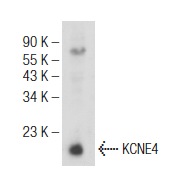
Western blot analysis of KCNE4 expression in mouse embryo tissue extract.| Product Name | KCNE4 Antibody (FL-170) |
|---|---|
| Antibody Type | Primary Antibodies |
| Antigen Alias | epitope corresponding to amino acids 1-170 representing full length KCNE4 of human origin |
| Modification Notes | The KCNE genes encode small, single transmembrane domain peptides that associate with pore-forming å-subunits to form K+ channels with unique characteristics. Voltage-gated K+ channels in the plasma membrane control the repolarization and the frequency of action potentials in neurons, muscles, and other excitable cells. KCNE4 (K+ voltage-gated channel, Isk-related family, member 4), also known as minimum K+ ion channel-related peptide 3 (MiRP3), belongs to a family of proteins known to have a dramatic effect on the gating of certain potassium channels. KCNE4 is expressed strongly in heart, skeletal muscle, and kidney. Electrophysiological studies show that human KCNE4 inhibits the KCNQ1 channel. KCNE4 also plays a role in inhibiting the currents of Kv1.1 and Kv1.3. Alternatively, it is a key player in increasing the current amplitude of the KCNQ4 channel. |
| Clonality | Polyclonal |
|---|---|
| Isotype | IgG |
| Host Species | Rabbit |
| Tested Applications | WBIPIFELISA |
| recommended for detection of KCNE4 of mouse, rat and human origin by WB, IP, IF and ELISA also reactive with additional species, including equine, canine, bovine and porcine: |
|
| Species Reactivity | HumanMouseRat |
| Concentration | 1mg/ml |
| Purification | Affinity purified |
| Alternative Names | epitope corresponding to amino acids 1-170 representing full length KCNE4 of human origin |
|---|---|
| Tissue Specificity | epitope corresponding to amino acids 1-170 representing full length KCNE4 of human origin |
| Entrez Gene | 23704 |
|---|
Application
Western blot analysis of KCNE4 expression in mouse embryo tissue extract.| Application Notes | recommended for detection of KCNE4 of mouse, rat and human origin by WB, IP, IF and ELISA also reactive with additional species, including equine, canine, bovine and porcine: |
|---|
| Form | Liquid |
|---|---|
| Storage Instructions | For short-term storage, store at 4° C. For long-term storage, aliquot and store at -20ºC or below. Avoid multiple freeze-thaw cycles. |
| Storage Buffer | phosphate buffered saline , pH 7.4, 150mM NaCl, 0.02% sodium azide and 50% glycerol. |


