Application
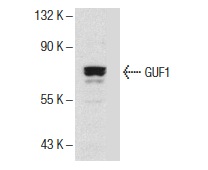
Western blot analysis of GUF1 expression in HeLa whole cell lysate.| Product Name | GUF1 Antibody (S-13) |
|---|---|
| Antibody Type | Primary Antibodies |
| Antigen Alias | epitope mapping near the C-terminus of GUF1 of human origin |
| Modification Notes | GUF1 (GUF1 GTPase), also known as EF-4 (elongation factor 4 homolog), translation factor GUF1 (mitochondrial), ribosomal back-translocase or GTPase of unknown function 1, is a 669 amino acid protein belonging to the GTP-binding elongation factor family and the LepA subfamily. Localizing to the mitochondrion inner membrane, GUF1 is thought to promote mitochondrial protein synthesis and binds to mitochondrial ribosomes in a GTP-dependent manner. GUF1 is suggested to catalyze a one-codon backward translocation of tRNAs on improperly translocated ribosomes, thereby acting as a fidelity factor of the translation reaction. GUF1 is encoded by a gene located on human chromosome 4, which encodes nearly 6% of the human genome and has the largest gene desert (regions of the genome with no protein encoding genes) of all of the human chromosomes. Defects in some of the genes located on chromosome 4 are associated with Huntington's disease, Ellis-van Creveld syndrome, methylmalonic acidemia and polycystic kidney disease. |
| Clonality | Polyclonal |
|---|---|
| Isotype | IgG |
| Host Species | Rabbit |
| Tested Applications | WBIPIFELISA |
| recommended for detection of GUF1 of mouse, rat and human origin by WB, IP, IF and ELISA also reactive with additional species, including equine, canine, bovine and porcine: |
|
| Species Reactivity | HumanMouseRat |
| Concentration | 1mg/ml |
| Purification | Affinity purified |
| Alternative Names | epitope mapping near the C-terminus of GUF1 of human origin |
|---|---|
| Tissue Specificity | epitope mapping near the C-terminus of GUF1 of human origin |
| Entrez Gene | 60558 |
|---|
Application
Western blot analysis of GUF1 expression in HeLa whole cell lysate.| Application Notes | recommended for detection of GUF1 of mouse, rat and human origin by WB, IP, IF and ELISA also reactive with additional species, including equine, canine, bovine and porcine: |
|---|
| Form | Liquid |
|---|---|
| Storage Instructions | For short-term storage, store at 4° C. For long-term storage, aliquot and store at -20ºC or below. Avoid multiple freeze-thaw cycles. |
| Storage Buffer | phosphate buffered saline , pH 7.4, 150mM NaCl, 0.02% sodium azide and 50% glycerol. |


