Application
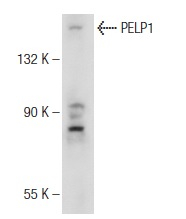
Western blot analysis of PELP1 expression in RAW 264.7 whole cell lysate.Application
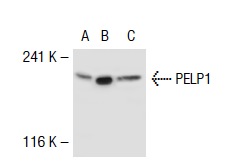
Western blot analysis of PELP1 expression in non-transfected 293T: (A), human PELP1 transfected 293T: (B) and HeLa (C) whole cell lysates.| Product Name | PELP1 Antibody (H-300) |
|---|---|
| Antibody Type | Primary Antibodies |
| Antigen Alias | epitope corresponding to amino acids 39-338 mapping near the N-terminus of PELP1 of human origin |
| Modification Notes | The estrogen receptor (ER) plays an important role in cancer progression. (Proline-, glutamic acid-, and leucine-rich protein-1)PELP1/MNAR [modulator of nongenomic activity of estrogen receptor (ER), a novel coregulatory protein, modulates genomic as well as nongenomic activity of estrogen receptors. PELP1 plays an essential role in the proliferation of cancerous endometrial cells. PELP1 expression, in both the stroma and epithelial cells, and localization are widely deregulated in endometrial cancers. In addition, PELP1 and ER beta localize predominantly in the cytoplasm of high-grade endometrial tumors. PELP1 coactivates ER-mediated transcription and also serves as a corepressor of other nuclear hormone receptors (NR)- and non-NR sequence-specific transcription factors, including GR, Nur77, AP1, NF-kappaB, and TCF/SRF. PELP1 participates in chromatin remodeling activity via displacement of histone 1 in cancer cells. It is expressed in all stages of endometrium. |
| Clonality | Polyclonal |
|---|---|
| Isotype | IgG |
| Host Species | Rabbit |
| Tested Applications | WBIPIFELISA |
| recommended for detection of PELP1 of mouse, rat and human origin by WB, IP, IF and ELISA also reactive with additional species, including equine, canine, bovine and porcine: |
|
| Species Reactivity | HumanMouseRat |
| Concentration | 1mg/ml |
| Purification | Affinity purified |
| Alternative Names | epitope corresponding to amino acids 39-338 mapping near the N-terminus of PELP1 of human origin |
|---|---|
| Tissue Specificity | epitope corresponding to amino acids 39-338 mapping near the N-terminus of PELP1 of human origin |
| Entrez Gene | 27043 |
|---|
Application
Western blot analysis of PELP1 expression in RAW 264.7 whole cell lysate.
Application
Western blot analysis of PELP1 expression in non-transfected 293T: (A), human PELP1 transfected 293T: (B) and HeLa (C) whole cell lysates.| Application Notes | recommended for detection of PELP1 of mouse, rat and human origin by WB, IP, IF and ELISA also reactive with additional species, including equine, canine, bovine and porcine: |
|---|
| Form | Liquid |
|---|---|
| Storage Instructions | For short-term storage, store at 4° C. For long-term storage, aliquot and store at -20ºC or below. Avoid multiple freeze-thaw cycles. |
| Storage Buffer | phosphate buffered saline , pH 7.4, 150mM NaCl, 0.02% sodium azide and 50% glycerol. |


