Application
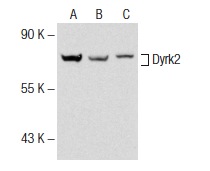
Western blot analysis of Dyrk2 expression in K-562 (A), PC-3 (B) and SK-MEL-28 (C) whole cell lysates.Application
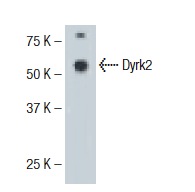
Western blot analysis of Dyrk2 expression in 293 whole cell lysate.| Product Name | Dyrk2 Antibody (S-23) |
|---|---|
| Antibody Type | Primary Antibodies |
| Antigen Alias | recommended for detection of Dyrk2 of human origin by WB, IF, IHC(P) and ELISA |
| Modification Notes | Dyrk (for dual specificity tyrosine phosphorylation regulated kinase) is the homolog of the Drosophila mnb (minibrain) gene, which is required for neurogenesis (1–3). Dyrk is a dual-specificity tyrosine kinase and serine/threonine kinase, which is itself regulated by tyrosine phosphorylation (1). Several mammalian Dyrk related proteins have been identified and are thought to compose a family of dual specificity protein kinases (4). Dyrk family members, including Dyrk1A (originally Dyrk), Dyrk1B, Dryk1C, Dyrk2, Dyrk3, Dyrk4A and Dyrk4B, are thought to be involved in diverse cellular functions (4). Dyrk1A is a candidate gene that may be involved in Downs syndrome, and it has been found to be somewhat overexpressed in Downs syndrome (1,5). Two isoforms of human fetal brain Dyrk2 exist: a deduced 528-amino acid protein and a protein containing 73 additional amino acids at the amino terminus (4). Dyrk3 is strongly expressed in testis, only after the onset of spermatogenesis, and very weakly expressed in spleen and adrenal gland (1). The genes which encode Dyrk2 and Dyrk3 map to human chromosomes 12 and 1q32, respectively (4). |
| Clonality | Polyclonal |
|---|---|
| Isotype | IgG |
| Host Species | Rabbit |
| Tested Applications | WBIFIHCELISA |
| WB:1:500~1:2000 IF:1:200~1:500 IHC:1:50~1:200 Notes:Optimal dilutions/concentrations should be determined by the researcher. |
|
| Species Reactivity | HumanMouseRat |
| Concentration | 1mg/ml |
| Purification | Affinity purified |
| Alternative Names | recommended for detection of Dyrk2 of human origin by WB IF IHC(P) and ELISA |
|---|---|
| Tissue Specificity | recommended for detection of Dyrk2 of human origin by WB, IF, IHC(P) and ELISA |
| Entrez Gene | 8445 |
|---|
Application
Western blot analysis of Dyrk2 expression in K-562 (A), PC-3 (B) and SK-MEL-28 (C) whole cell lysates.
Application
Western blot analysis of Dyrk2 expression in 293 whole cell lysate.| Application Notes | WB:1:500~1:2000 IF:1:200~1:500 IHC:1:50~1:200 Notes:Optimal dilutions/concentrations should be determined by the researcher. |
|---|
| Form | Liquid |
|---|---|
| Storage Instructions | For short-term storage, store at 4° C. For long-term storage, aliquot and store at -20ºC or below. Avoid multiple freeze-thaw cycles. |
| Storage Buffer | phosphate buffered saline , pH 7.4, 150mM NaCl, 0.02% sodium azide and 50% glycerol. |


