Application
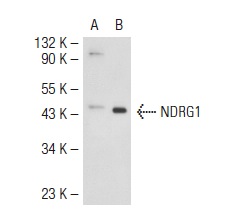
Western blot analysis of NDRG1 expression in non-transfected: (A) and human NDRG1 transfected: (B) 293T whole cell lysates.Application
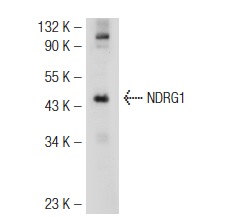
Western blot analysis of NDRG1 expression in 293T whole cell lysate.| Product Name | NDRG1 Antibody (H-60) |
|---|---|
| Antibody Type | Primary Antibodies |
| Antigen Alias | epitope corresponding to amino acids 331-390 mapping at the C-terminus of NDRG1 of human origin |
| Modification Notes | The N-myc downstream regulated gene (NDRG) family is comprised of four members, NDRG1 (also designated Drg1, RTP, rit42, Cap43 and Ndr1), NDRG2, NDRG3 and NDRG4, which share 57-65% homology (1). The NDRG1 gene, which maps to human chromosome 8q24.22, is evolutionarily conserved and is similarly regulated in humans, mice and rats (2,3). Like NDRG2 and NDRG3, NDRG1 is ubiquitously expressed, but it is expressed most prominently in placental membranes and prostate, kidney, small intestine and ovary tissue (1,4). NDRG1 gene expression is induced by several compounds, including nickel, and produces a protein involved in stress responses, hormone responses, cell growth and differentiation (1,3,5,6). The gene encoding NDRG3 maps to human chromosome 20q11.23 and is predominantly expressed in testis, prostate and ovary, which suggests it may play a role in spermatogenesis (7 |
| Clonality | Polyclonal |
|---|---|
| Isotype | IgG |
| Host Species | Rabbit |
| Tested Applications | WBIPIFELISA |
| recommended for detection of NDRG1 of mouse, rat and human origin by WB, IP, IF and ELISA: |
|
| Species Reactivity | HumanMouseRat |
| Concentration | 1mg/ml |
| Purification | Affinity purified |
| Alternative Names | epitope corresponding to amino acids 331-390 mapping at the C-terminus of NDRG1 of human origin |
|---|---|
| Tissue Specificity | epitope corresponding to amino acids 331-390 mapping at the C-terminus of NDRG1 of human origin |
| Entrez Gene | 10397 |
|---|
Application
Western blot analysis of NDRG1 expression in non-transfected: (A) and human NDRG1 transfected: (B) 293T whole cell lysates.
Application
Western blot analysis of NDRG1 expression in 293T whole cell lysate.| Application Notes | recommended for detection of NDRG1 of mouse, rat and human origin by WB, IP, IF and ELISA: |
|---|
| Form | Liquid |
|---|---|
| Storage Instructions | For short-term storage, store at 4° C. For long-term storage, aliquot and store at -20ºC or below. Avoid multiple freeze-thaw cycles. |
| Storage Buffer | phosphate buffered saline , pH 7.4, 150mM NaCl, 0.02% sodium azide and 50% glycerol. |


