Application
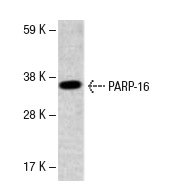
Western blot analysis of PARP-16 expression in human fetal kidney tissue extract.| Product Name | PARP-16 Antibody (A-25) |
|---|---|
| Antibody Type | Primary Antibodies |
| Antigen Alias | recommended for detection of PARP-16 of human origin by WB, IP and ELISA |
| Modification Notes | Poly(ADP-ribosylation) is a method of DNA damage-dependent posttranslational modification that helps to rescue injured proliferating cells from cell death. The PARP (poly(ADP-ribose) polymerase) proteins comprise a superfamily of enzymes that functionally modify histones and other nuclear proteins, thereby preventing cell death. PARPs use NAD+ as a substrate to catalytically transfer ADP-ribose residues onto protein acceptors; a process that, when repeated multiple times, leads to the formation of poly(ADPribose) chains on the protein. The presence of these chains alters the function of the target protein and promotes cell survival. PARP proteins are implicated in a variety of diseases, including cancer, neurodegenerative and inflammatory disorders. PARP-16 is a 322 amino acid poly (ADP-ribose) polymerase protein localized to the membrane. Expressed as three isoforms produced by alternative splicing, PARP-16 contains one PARP catalytic domain. |
| Clonality | Polyclonal |
|---|---|
| Isotype | IgG |
| Host Species | Rabbit |
| Tested Applications | WBIPELISA |
| WB:1:500~1:2000 IP:1:100~1:500 Notes:Optimal dilutions/concentrations should be determined by the researcher. |
|
| Species Reactivity | HumanMouseRat |
| Concentration | 1mg/ml |
| Purification | Affinity purified |
| Alternative Names | recommended for detection of PARP-16 of human origin by WB IP and ELISA |
|---|---|
| Tissue Specificity | recommended for detection of PARP-16 of human origin by WB, IP and ELISA |
| Entrez Gene | 54956 |
|---|
Application
Western blot analysis of PARP-16 expression in human fetal kidney tissue extract.| Application Notes | WB:1:500~1:2000 IP:1:100~1:500 Notes:Optimal dilutions/concentrations should be determined by the researcher. |
|---|
| Form | Liquid |
|---|---|
| Storage Instructions | For short-term storage, store at 4° C. For long-term storage, aliquot and store at -20ºC or below. Avoid multiple freeze-thaw cycles. |
| Storage Buffer | phosphate buffered saline , pH 7.4, 150mM NaCl, 0.02% sodium azide and 50% glycerol. |


