Application
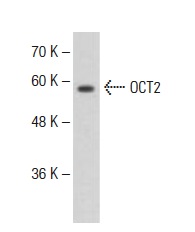
Western blot analysis of OCT2 expression in Hep G2 whole cell lysate.| Product Name | OCT2 Antibody (X-22) |
|---|---|
| Antibody Type | Primary Antibodies |
| Antigen Alias | recommended for detection of OCT2 of human origin by WB, IP and ELISA |
| Modification Notes | Organic cation transporters (OCT) are expressed in the plasma membrane of epithelial cells from a wide range of tissues, where they function in the elimination of endogenous amines, cationic drugs and other xenobiotics. The structure of OCTs consists of a 12-transmembrane-domain structure and a large extracellular hydrophilic loop. In humans, OCT1 is primarily expressed in the liver, while OCT2 is expressed in the kidney. OCT3 is expressed in the placenta, skeletal muscle, prostate, aorta and liver. OCT2, also known as SLC22A2, is a multi-specific transporter protein localizing to the basolateral and luminal membranes of the kidney distal tubule and proximal tubules. OCT2 is responsible for mediating the pH-sensitive tubular uptake of organic compounds from circulation. An additional splice variant exists for OCT2, namely OCT2-A. |
| Clonality | Polyclonal |
|---|---|
| Isotype | IgG |
| Host Species | Rabbit |
| Tested Applications | WBIPELISA |
| WB:1:500~1:2000 IP:1:100~1:500 Notes:Optimal dilutions/concentrations should be determined by the researcher. |
|
| Species Reactivity | HumanMouseRat |
| Concentration | 1mg/ml |
| Purification | Affinity purified |
| Alternative Names | recommended for detection of OCT2 of human origin by WB IP and ELISA |
|---|---|
| Tissue Specificity | recommended for detection of OCT2 of human origin by WB, IP and ELISA |
| Entrez Gene | 6582 |
|---|
Application
Western blot analysis of OCT2 expression in Hep G2 whole cell lysate.| Application Notes | WB:1:500~1:2000 IP:1:100~1:500 Notes:Optimal dilutions/concentrations should be determined by the researcher. |
|---|
| Form | Liquid |
|---|---|
| Storage Instructions | For short-term storage, store at 4° C. For long-term storage, aliquot and store at -20ºC or below. Avoid multiple freeze-thaw cycles. |
| Storage Buffer | phosphate buffered saline , pH 7.4, 150mM NaCl, 0.02% sodium azide and 50% glycerol. |


