Application
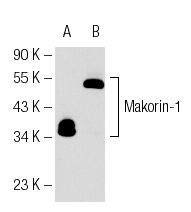
Western blot analysis of Makorin-1 expression in non-transfected: (A) and human Makorin-1 transfected: (B) 293T whole cell lysates.| Product Name | Makorin-1 Antibody (Z-21) |
|---|---|
| Antibody Type | Primary Antibodies |
| Antigen Alias | recommended for detection of Makorin-1 of mouse and human origin by WB, IP and ELISA; also reactive with additional species, including canine |
| Modification Notes | The Makorins are a family of proteins containing two to four C3H zinc fingers that may confer RNA-binding. In addition, they contain a C3HC4 RING zinc finger that allows them to function as E3 ubiquitin ligases. Makorin-1, also designated RING finger protein 61, is a ubiquitously expressed member of the Makorin family that mediates the ubiquitination of human TERT. The overexpression of Makorin-1 produces a variety of effects. In telomerase-positive cells, Makorin-1 overexpression promotes TERT degradation and reduces the activity of telomerase, leading to a reduction in telomere length. Overexpression of Makorin-1 also inhibits the transcriptional activities of c-Jun, the nuclear receptors, the androgen receptor and the retinoic acid receptors. The inhibitory activity of Makorin-1 requires both the amino and carboxy termini but not functioning ubiquitin ligase activity. The less common function of Makorin-1 as an activator also requires both the amino and carboxy termini. |
| Clonality | Polyclonal |
|---|---|
| Isotype | IgG |
| Host Species | Rabbit |
| Tested Applications | WBIPELISA |
| WB:1:500~1:2000 IP:1:100~1:500 Notes:Optimal dilutions/concentrations should be determined by the researcher. |
|
| Species Reactivity | HumanMouseRat |
| Concentration | 1mg/ml |
| Purification | Affinity purified |
| Alternative Names | recommended for detection of Makorin-1 of mouse and human origin by WB IP and ELISA also reactive with additional species including canine |
|---|---|
| Tissue Specificity | recommended for detection of Makorin-1 of mouse and human origin by WB, IP and ELISA; also reactive with additional species, including canine |
| Entrez Gene | 23608 |
|---|
Application
Western blot analysis of Makorin-1 expression in non-transfected: (A) and human Makorin-1 transfected: (B) 293T whole cell lysates.| Application Notes | WB:1:500~1:2000 IP:1:100~1:500 Notes:Optimal dilutions/concentrations should be determined by the researcher. |
|---|
| Form | Liquid |
|---|---|
| Storage Instructions | For short-term storage, store at 4° C. For long-term storage, aliquot and store at -20ºC or below. Avoid multiple freeze-thaw cycles. |
| Storage Buffer | phosphate buffered saline , pH 7.4, 150mM NaCl, 0.02% sodium azide and 50% glycerol. |


