Application
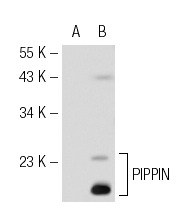
Western blot analysis of PIPPIN expression in non-transfected: (A) and human PIPPIN transfected: (B) 293T whole cell lysates.| Product Name | PIPPIN Antibody (C-12) |
|---|---|
| Antibody Type | Primary Antibodies |
| Antigen Alias | epitope mapping near the C-terminus of PIPPIN of human origin |
| Modification Notes | PIPPIN, also known as CSDC2 (cold shock domain containing C2, RNA binding), is a Y-box protein (also called cold-shock (CSD) domain-containing protein) and belongs to a family of highly conserved RNA-binding transcriptional regulators. Predominantly expressed in brain cells and localizing to the nucleus and the cytoplasm, PIPPIN contains two RNA-binding motifs, namely PIP1 and PIP2, and one CSD domain. PIPPIN functions as a nucleic acid binding regulatory factor and is believed to participate in brain maturation. More specifically, PIPPIN binds to the 3’-UTR ends of the mRNAs encoding Histone H1 and Histone H3.3. This interaction requires all of the PIPPIN domains to work in concert as one functional protein. In addition, PIPPIN can be sumoylated in a thyroid hormone (T3)-dependent manner. This suggests that PIPPIN modification in response to extracellular stimuli may modulate the regulation of protein synthesis. |
| Clonality | Polyclonal |
|---|---|
| Isotype | IgG |
| Host Species | Rabbit |
| Tested Applications | WBIFELISA |
| recommended for detection of PIPPIN of mouse, rat and human origin by WB, IF and ELISA also reactive with additional species, including equine, canine, bovine and porcine: |
|
| Species Reactivity | HumanMouseRat |
| Concentration | 1mg/ml |
| Purification | Affinity purified |
| Alternative Names | epitope mapping near the C-terminus of PIPPIN of human origin |
|---|---|
| Tissue Specificity | epitope mapping near the C-terminus of PIPPIN of human origin |
| Entrez Gene | 27254 |
|---|
Application
Western blot analysis of PIPPIN expression in non-transfected: (A) and human PIPPIN transfected: (B) 293T whole cell lysates.| Application Notes | recommended for detection of PIPPIN of mouse, rat and human origin by WB, IF and ELISA also reactive with additional species, including equine, canine, bovine and porcine: |
|---|
| Form | Liquid |
|---|---|
| Storage Instructions | For short-term storage, store at 4° C. For long-term storage, aliquot and store at -20ºC or below. Avoid multiple freeze-thaw cycles. |
| Storage Buffer | phosphate buffered saline , pH 7.4, 150mM NaCl, 0.02% sodium azide and 50% glycerol. |


