Application
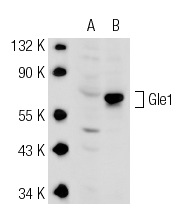
Western blot analysis of Gle1 expression in non-transfected: (A) and human Gle1 transfected: (B) 293T whole cell lysates.Application
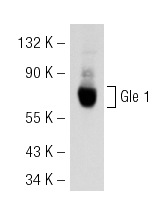
Western blot analysis of Gle1 expression in mouse thymus tissue extract.| Product Name | Gle1 Antibody (H-300) |
|---|---|
| Antibody Type | Primary Antibodies |
| Antigen Alias | epitope corresponding to amino acids 399-698 mapping at the C-terminus of Gle1 of human origin |
| Modification Notes | Protein transport across the nucleus is a selective, multi-step process involving several cytoplasmic factors that mediate protein passage through the nuclear pore complex (NPC). Gle1, also known as GLE1L, is a 698 amino acid protein that localizes to both the nucleus and the cytoplasm and belongs to the Gle1 family. Expressed as two alternatively spliced isoforms, Gle1 associates with the NPC and is required for the transport of poly(A)-containing mRNAs from the nucleus to the cytoplasm. Defects in the gene encoding Gle1 are the cause of lethal congenital contracture syndrome type 1 (LCCS1) and lethal arthrogryposis with anterior horn cell disease (LAAHD), the former of which is characterized by early fetal hydrops and akinesia, micrognatia, pulmonary hypoplasia, pterygia and prenatal death, while the latter is associated with respiratory failure. |
| Clonality | Polyclonal |
|---|---|
| Isotype | IgG |
| Host Species | Rabbit |
| Tested Applications | WBIPIFELISA |
| recommended for detection of Gle1 of mouse, rat and human origin by WB, IP, IF and ELISA also reactive with additional species, including equine, canine, bovine and porcine: |
|
| Species Reactivity | HumanMouseRat |
| Concentration | 1mg/ml |
| Purification | Affinity purified |
| Alternative Names | epitope corresponding to amino acids 399-698 mapping at the C-terminus of Gle1 of human origin |
|---|---|
| Tissue Specificity | epitope corresponding to amino acids 399-698 mapping at the C-terminus of Gle1 of human origin |
| Entrez Gene | 2733 |
|---|
Application
Western blot analysis of Gle1 expression in non-transfected: (A) and human Gle1 transfected: (B) 293T whole cell lysates.
Application
Western blot analysis of Gle1 expression in mouse thymus tissue extract.| Application Notes | recommended for detection of Gle1 of mouse, rat and human origin by WB, IP, IF and ELISA also reactive with additional species, including equine, canine, bovine and porcine: |
|---|
| Form | Liquid |
|---|---|
| Storage Instructions | For short-term storage, store at 4° C. For long-term storage, aliquot and store at -20ºC or below. Avoid multiple freeze-thaw cycles. |
| Storage Buffer | phosphate buffered saline , pH 7.4, 150mM NaCl, 0.02% sodium azide and 50% glycerol. |


