Application
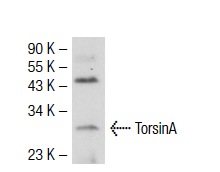
Western blot analysis of TorsinA expression in NIH/3T3 whole cell lysate.| Product Name | TorsinA Antibody (H-85) |
|---|---|
| Antibody Type | Primary Antibodies |
| Antigen Alias | epitope corresponding to amino acids 176-260 mapping within an internal region of TorsinA of human origin |
| Modification Notes | A mutation of the DYT1 gene, which codes for TorsinA, has been identified as the cause of one form of autosomal dominantly inherited dystonia. Early-onset torsion dystonia is a movement disorder, characterized by twisting muscle contractures, that begins in childhood. Symptoms are believed to result from altered neuronal communication in the basal ganglia. TorsinA comprises 332 amino acids. TorsinA is widely expressed throughout the mouse central nervous system and is detected in the majority of neurons in nearly all regions. The proteins display cytoplasmic distribution, although in some types of neurons localization is perinuclear. TorsinA often performs chaperone-like functions that assist in the assembly, operation, or dis-assembly of protein complexes. The gene which encodes TorsinA has high homology to three additional mammalian genes and a nematode gene and distal similarity to the family of heat-shock proteins and the Clp protease family. The gene which encodes TorsinA maps to human chromosome 9q34. |
| Clonality | Polyclonal |
|---|---|
| Isotype | IgG |
| Host Species | Rabbit |
| Tested Applications | WBIPIFELISA |
| recommended for detection of TorsinA and, to a lesser extent, TorsinB of mouse, rat and human origin by WB, IP, IF and ELISA also reactive with additional species, including equine, canine, bovine and porcine: |
|
| Species Reactivity | HumanMouseRat |
| Concentration | 1mg/ml |
| Purification | Affinity purified |
| Alternative Names | epitope corresponding to amino acids 176-260 mapping within an internal region of TorsinA of human origin |
|---|---|
| Tissue Specificity | epitope corresponding to amino acids 176-260 mapping within an internal region of TorsinA of human origin |
| Entrez Gene | 1861 |
|---|
Application
Western blot analysis of TorsinA expression in NIH/3T3 whole cell lysate.| Application Notes | recommended for detection of TorsinA and, to a lesser extent, TorsinB of mouse, rat and human origin by WB, IP, IF and ELISA also reactive with additional species, including equine, canine, bovine and porcine: |
|---|
| Form | Liquid |
|---|---|
| Storage Instructions | For short-term storage, store at 4° C. For long-term storage, aliquot and store at -20ºC or below. Avoid multiple freeze-thaw cycles. |
| Storage Buffer | phosphate buffered saline , pH 7.4, 150mM NaCl, 0.02% sodium azide and 50% glycerol. |


