Application
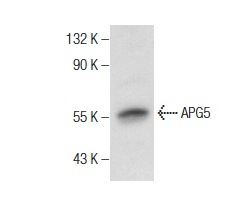
Western blot analysis of APG5 expression in SH-SY5Y whole cell lysate.| Product Name | APG5 Antibody (FL-275) |
|---|---|
| Antibody Type | Primary Antibodies |
| Antigen Alias | epitope corresponding to amino acids 1-275 representing full length APG5 of human origin |
| Modification Notes | In yeast, autophagy is an essential process for survival during nutrient starvation and cell differentiation. The process of autophagy is characterized as a non-selective degradation of cytoplasmic proteins into membrane stuctures called autophagosomes, and it is dependent on several proteins, including the autophagy proteins APG5 and APG7. Yeast Apg7 and the human homolog, APG7, share similarities with the ubiquitin-activating enzyme E1 in Saccharomyces cerevisiae and are likewise responsible for enzymatically activating the autophagy conjugation system. Apg5 and the human homolog, APG5 (also designated apoptosis-specific protein or APS), function as substrates for the autophagy protein Apg12. These proteins are covalently bonded together to form Apg12/APG5 conjugates, which are required for the progression of autophagy. |
| Clonality | Polyclonal |
|---|---|
| Isotype | IgG |
| Host Species | Rabbit |
| Tested Applications | WBIPIFELISA |
| recommended for detection of APG5 long and short isoforms of human origin and APG5 of mouse and rat origin by WB, IP, IF and ELISA also reactive with additional species, including equine, canine, bovine, porcine and avian: |
|
| Species Reactivity | HumanMouseRat |
| Concentration | 1mg/ml |
| Purification | Affinity purified |
| Alternative Names | epitope corresponding to amino acids 1-275 representing full length APG5 of human origin |
|---|---|
| Tissue Specificity | epitope corresponding to amino acids 1-275 representing full length APG5 of human origin |
| Entrez Gene | 9474 |
|---|
Application
Western blot analysis of APG5 expression in SH-SY5Y whole cell lysate.| Application Notes | recommended for detection of APG5 long and short isoforms of human origin and APG5 of mouse and rat origin by WB, IP, IF and ELISA also reactive with additional species, including equine, canine, bovine, porcine and avian: |
|---|
| Form | Liquid |
|---|---|
| Storage Instructions | For short-term storage, store at 4° C. For long-term storage, aliquot and store at -20ºC or below. Avoid multiple freeze-thaw cycles. |
| Storage Buffer | phosphate buffered saline , pH 7.4, 150mM NaCl, 0.02% sodium azide and 50% glycerol. |


