Application
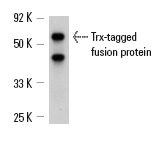
Western blot analysis of Trx-tagged fusion protein.| Product Name | Trx Antibody (K-20) |
|---|---|
| Antibody Type | Primary Antibodies |
| Antigen Alias | epitope mapping near the C-terminus of the thioredoxin-encoded domain of pTrx Fus expression plasmid |
| Modification Notes | Plasmid vectors for the expression of coding regions of eukaryotic genes in bacterial, insect and mammalian hosts are in common usage; such expression vectors frequently encode hybrid fusion proteins consisting in part of prokaryotic- and in part of eukaryotic-specified proteins (1-4). Most of the successful fusion protein vectors position the protein of interest at the carboxy terminal end of the highly-expressed fusion partner to ensure efficient translation initiation. One such expression system is based on the use of the E. coli thioredoxin (trxA) as the fusion partner (5,6). When overexpressed from plasmid vectors, E. coli thioredoxin can accumulate up to 40% of the total cellular protein. Even at these high levels of expression, most of the fusion protein is present in soluble form (6,7). Two features that facilitate purification of thioredoxin fusion proteins include inherent heat stability and localization between the inner and outer membranes of the E. coli cell envelope (6). This latter feature facilitates purification of the fusion proteins by either simple osmotic shock or freeze/thaw treatment (8). |
| Clonality | Polyclonal |
|---|---|
| Isotype | IgG |
| Host Species | Rabbit |
| Tested Applications | WBIPELISA |
| recommended for detection of thioredoxin and pTrx Fus-encoded fusion proteins by WB, IP and ELISA: |
|
| Species Reactivity | HumanMouseRat |
| Concentration | 1mg/ml |
| Purification | Affinity purified |
| Alternative Names | epitope mapping near the C-terminus of the thioredoxin-encoded domain of pTrx Fus expression plasmid |
|---|---|
| Tissue Specificity | epitope mapping near the C-terminus of the thioredoxin-encoded domain of pTrx Fus expression plasmid |
Application
Western blot analysis of Trx-tagged fusion protein.| Application Notes | recommended for detection of thioredoxin and pTrx Fus-encoded fusion proteins by WB, IP and ELISA: |
|---|
| Form | Liquid |
|---|---|
| Storage Instructions | For short-term storage, store at 4° C. For long-term storage, aliquot and store at -20ºC or below. Avoid multiple freeze-thaw cycles. |
| Storage Buffer | phosphate buffered saline , pH 7.4, 150mM NaCl, 0.02% sodium azide and 50% glycerol. |


