Application
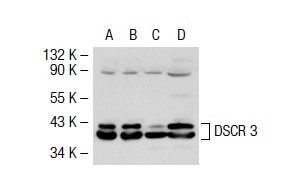
Western blot analysis of DSCR 3 expression in non-transfected 293T: (A), human DSCR 3 transfected 293T: (B), HeLa (C) and Jurkat (D) whole cell lysates.| Product Name | DSCR 3 Antibody (P-20) |
|---|---|
| Antibody Type | Primary Antibodies |
| Antigen Alias | epitope mapping within an internal region of DSCR 3 of human origin |
| Modification Notes | An extra copy of chromosome 21, the smallest human autosome chromosome, results in Down syndrome. Down syndrome is a genetic disorder characterized by congenital heart abnormalities and mental retardation. The Down Syndrome Critical Region (DSCR) maps specifically to chromosome 21q22.2 and includes several genes which are likely associated with the pathogenesis of Down syndrome. Symptoms include abnormal neuronal differentiation and elevated apoptosis in the developing brain. DSCR 3 (Down syndrome critical region protein 3), also known as DCRA or DSCRA, is a ubiquitously expressed 297 amino acid protein. In addition to its location in the DSCR region of chromosome 21, DSCR 3 is located within the CBR-ERG region that has been associated with partial trisomy 21 patients. This region contributes to the characteristic morphological features, mental retardation and hypotonia of Down syndrome patients. |
| Clonality | Polyclonal |
|---|---|
| Isotype | IgG |
| Host Species | Rabbit |
| Tested Applications | WBIPIFELISA |
| recommended for detection of DSCR 3 of mouse, rat and human origin by WB, IP, IF and ELISA non cross-reactive with other DSCR family members also reactive with additional species, including equine, canine, bovine and avian: |
|
| Species Reactivity | HumanMouseRat |
| Concentration | 1mg/ml |
| Purification | Affinity purified |
| Alternative Names | epitope mapping within an internal region of DSCR 3 of human origin |
|---|---|
| Tissue Specificity | epitope mapping within an internal region of DSCR 3 of human origin |
| Entrez Gene | 10311 |
|---|
Application
Western blot analysis of DSCR 3 expression in non-transfected 293T: (A), human DSCR 3 transfected 293T: (B), HeLa (C) and Jurkat (D) whole cell lysates.| Application Notes | recommended for detection of DSCR 3 of mouse, rat and human origin by WB, IP, IF and ELISA non cross-reactive with other DSCR family members also reactive with additional species, including equine, canine, bovine and avian: |
|---|
| Form | Liquid |
|---|---|
| Storage Instructions | For short-term storage, store at 4° C. For long-term storage, aliquot and store at -20ºC or below. Avoid multiple freeze-thaw cycles. |
| Storage Buffer | phosphate buffered saline , pH 7.4, 150mM NaCl, 0.02% sodium azide and 50% glycerol. |


