Application
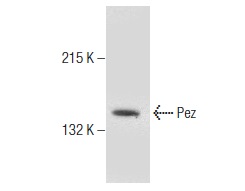
Western blot analysis of Pez expression in K-562 whole cell lysate.| Product Name | Pez Antibody (H-67) |
|---|---|
| Antibody Type | Primary Antibodies |
| Antigen Alias | epitope corresponding to amino acids 321-387 mapping within an internal region of Pez of human origin |
| Modification Notes | Pez (protein tyrosine phosphatase Pez), also known as PTP36 or Tyrosine-protein phosphatase non-receptor type 14 (PTPN14), is a member of the non-receptor class subfamily of the protein tyrosine phosphatase family. Protein tyrosine phosphatases (PTPs) are involved in the regulation of a variety of cellular processes. Pez is a cytosolic protein (concentrated at the intercellular junctions) that is expressed in various tissues including placenta, lung, kidney and skeletal muscle. It contains one protein tyrosine phosphatase domain and one FERM (4.1, ezrin, radixin, moesin) domain. In actively proliferating cells, where cell-cell contacts have been disrupted, Pez translocates to the nucleus. TGF∫, a protein known to inhibit cell proliferation, can inhibit the nuclear translocation of Pez. Localization of Pez is also regulated by serum concentrations; higher serum concentrations can lead to the accumulation of Pez in the nucleus. This strongly suggests a role for Pez in cell proliferation. |
| Clonality | Polyclonal |
|---|---|
| Isotype | IgG |
| Host Species | Rabbit |
| Tested Applications | WBIPIFELISA |
| recommended for detection of Pez, also designated Tyrosine-protein phosphatase non-receptor type 14, of mouse, rat and human origin by WB, IP, IF and ELISA also reactive with additional species, including equine, canine, bovine and porcine: |
|
| Species Reactivity | HumanMouseRat |
| Concentration | 1mg/ml |
| Purification | Affinity purified |
| Alternative Names | epitope corresponding to amino acids 321-387 mapping within an internal region of Pez of human origin |
|---|---|
| Tissue Specificity | epitope corresponding to amino acids 321-387 mapping within an internal region of Pez of human origin |
| Entrez Gene | 5784 |
|---|
Application
Western blot analysis of Pez expression in K-562 whole cell lysate.| Application Notes | recommended for detection of Pez, also designated Tyrosine-protein phosphatase non-receptor type 14, of mouse, rat and human origin by WB, IP, IF and ELISA also reactive with additional species, including equine, canine, bovine and porcine: |
|---|
| Form | Liquid |
|---|---|
| Storage Instructions | For short-term storage, store at 4° C. For long-term storage, aliquot and store at -20ºC or below. Avoid multiple freeze-thaw cycles. |
| Storage Buffer | phosphate buffered saline , pH 7.4, 150mM NaCl, 0.02% sodium azide and 50% glycerol. |


