Application
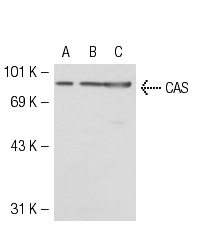
Western blot analysis of CAS expression in non-transfected: (A) and human CAS transfected: (B) 293T whole cell lysates and SW480 nuclear extract (C).| Product Name | CAS Antibody (H-300) |
|---|---|
| Antibody Type | Primary Antibodies |
| Antigen Alias | epitope corresponding to amino acids 672-971 mapping at the C-terminus of CAS of human origin |
| Modification Notes | Cellular apoptosis susceptibility protein (CAS), also called Exportin 2, is a 971 amino acid member of the CSE1 family. CAS mediates Importin å re-export from the nucleus to the cytoplasm after import substrates have been released into the nucleoplasm. In the nucleus, CAS binds cooperatively to Importin å and to the GTPase Ran in its GTP-bound (active) form. This complex binds to nucleoporins as it docks to the nuclear pore complex. Once in the cytoplasm, the complex dissociates and Importin å is released and CAS returns to the nuclear compartment and the process begins anew. CAS can be detected highly in proliferating cells. Three isoforms of CAS have been named due to alternative splicing. Isoform 1 is the full length, 971 amino acid protein. Isoform 2 contains an alternative sequence for amino acids 190-195 and is missing amino acids 196-971. Isoform 3 contains an alternative sequence for amino acids 943-945 and is missing amino acids 946-971. |
| Clonality | Polyclonal |
|---|---|
| Isotype | IgG |
| Host Species | Rabbit |
| Tested Applications | WBIPIFELISA |
| recommended for detection of CAS of mouse, rat and human origin by WB, IP, IF and ELISA also reactive with additional species, including equine, canine, bovine, porcine and avian: |
|
| Species Reactivity | HumanMouseRat |
| Concentration | 1mg/ml |
| Purification | Affinity purified |
| Alternative Names | epitope corresponding to amino acids 672-971 mapping at the C-terminus of CAS of human origin |
|---|---|
| Tissue Specificity | epitope corresponding to amino acids 672-971 mapping at the C-terminus of CAS of human origin |
| Entrez Gene | 1434 |
|---|
Application
Western blot analysis of CAS expression in non-transfected: (A) and human CAS transfected: (B) 293T whole cell lysates and SW480 nuclear extract (C).| Application Notes | recommended for detection of CAS of mouse, rat and human origin by WB, IP, IF and ELISA also reactive with additional species, including equine, canine, bovine, porcine and avian: |
|---|
| Form | Liquid |
|---|---|
| Storage Instructions | For short-term storage, store at 4° C. For long-term storage, aliquot and store at -20ºC or below. Avoid multiple freeze-thaw cycles. |
| Storage Buffer | phosphate buffered saline , pH 7.4, 150mM NaCl, 0.02% sodium azide and 50% glycerol. |


