Application
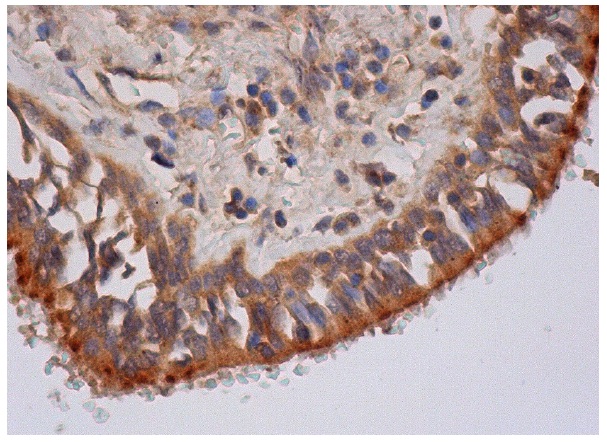
Immunoperoxidase staining of formalin fixed, paraffin-embedded human bronchus tissue showing cytoplasmic staining of respiratory epithelial cells.| Product Name | PCM1 Antibody (H-262) |
|---|---|
| Antibody Type | Primary Antibodies |
| Antigen Alias | epitope corresponding to amino acids 1-262 mapping at the N-terminus of PCM1 of human origin |
| Modification Notes | Pericentriolar Material is a dynamic substance whose composition can oscillate during the cell cycle. PCM1 (Pericentriolar Material 1), is a centrosomal protein that demonstrates a distinct cell cycle-dependent association with the centrosome complex. PCM1 is securely associated with the centrosome complex through G1, S, and a portion of G2. However, late in G2, as cells prepare for mitosis, PCM1 dissociates from the centrosome and then remains evenly diffused throughout the cell during mitosis before re-associating with the centrosomes in the G1 phase progeny cells. The chromosomal localization of the PCM1 on chromosome 8p22-p21.3 is one of interest since this region is commonly deleted in several tumors. In thyroid tumor tissue, PCM1 expression drastically decreases and its subcellular localization is shifted. |
| Clonality | Polyclonal |
|---|---|
| Isotype | IgG |
| Host Species | Rabbit |
| Tested Applications | WBIPIFIHCELISA |
| recommended for detection of PCM1 of mouse, rat and human origin by WB, IP, IF, IHC(P) and ELISA also reactive with additional species, including equine, canine and bovine: |
|
| Species Reactivity | HumanMouseRat |
| Concentration | 1mg/ml |
| Purification | Affinity purified |
| Alternative Names | epitope corresponding to amino acids 1-262 mapping at the N-terminus of PCM1 of human origin |
|---|---|
| Tissue Specificity | epitope corresponding to amino acids 1-262 mapping at the N-terminus of PCM1 of human origin |
| Entrez Gene | 5108 |
|---|
Application
Immunoperoxidase staining of formalin fixed, paraffin-embedded human bronchus tissue showing cytoplasmic staining of respiratory epithelial cells.| Application Notes | recommended for detection of PCM1 of mouse, rat and human origin by WB, IP, IF, IHC(P) and ELISA also reactive with additional species, including equine, canine and bovine: |
|---|
| Form | Liquid |
|---|---|
| Storage Instructions | For short-term storage, store at 4° C. For long-term storage, aliquot and store at -20ºC or below. Avoid multiple freeze-thaw cycles. |
| Storage Buffer | phosphate buffered saline , pH 7.4, 150mM NaCl, 0.02% sodium azide and 50% glycerol. |


