Application
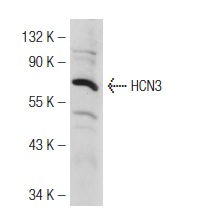
Western blot analysis of HCN3 expression in rat brain tissue extract.| Product Name | HCN3 Antibody (H-150) |
|---|---|
| Antibody Type | Primary Antibodies |
| Antigen Alias | epitope corresponding to amino acids 625-774 mapping within a C-terminal cytoplasmic domain of HCN3 of human origin |
| Modification Notes | Hyperpolarization-activated, cyclic nucleotide-binding channels (HCN) are voltage-gated cation channels that are activated by direct binding of intracellular cyclic nucleotides. The HCN family consists of four members (HCN1-4), each with a core transmembrane segment domain and a C-terminal 120 amino-acid cyclic nucleotide-binding domain motif. HCN channels are expressed in the brain, heart, thalamus and testis. The pacemaker properties of HCN channels contribute to spontaneous rhythmic activity in the brain and heart. HCN3 contains a segment characterized by a series of positively charged amino acids at every third position. This region designated S4 is likely to be the voltage sensor of the protein. In the brain, HCN3 and HCN4 exhibit subcortical distribution mainly concentrated in the hypothalamus and thalamus, respectively. |
| Clonality | Polyclonal |
|---|---|
| Isotype | IgG |
| Host Species | Rabbit |
| Tested Applications | WBIPIFELISA |
| recommended for detection of HCN3 of mouse, rat and human origin by WB, IP, IF and ELISA also reactive with additional species, including equine, canine, bovine and porcine: |
|
| Species Reactivity | HumanMouseRat |
| Concentration | 1mg/ml |
| Purification | Affinity purified |
| Alternative Names | epitope corresponding to amino acids 625-774 mapping within a C-terminal cytoplasmic domain of HCN3 of human origin |
|---|---|
| Tissue Specificity | epitope corresponding to amino acids 625-774 mapping within a C-terminal cytoplasmic domain of HCN3 of human origin |
| Entrez Gene | 57657 |
|---|
Application
Western blot analysis of HCN3 expression in rat brain tissue extract.| Application Notes | recommended for detection of HCN3 of mouse, rat and human origin by WB, IP, IF and ELISA also reactive with additional species, including equine, canine, bovine and porcine: |
|---|
| Form | Liquid |
|---|---|
| Storage Instructions | For short-term storage, store at 4° C. For long-term storage, aliquot and store at -20ºC or below. Avoid multiple freeze-thaw cycles. |
| Storage Buffer | phosphate buffered saline , pH 7.4, 150mM NaCl, 0.02% sodium azide and 50% glycerol. |


