Application
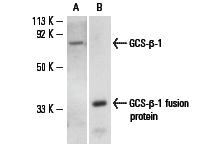
Western blot analysis of GCS β1 expression in mouse placenta extract (A) and human recombinant GCS β1 fusion protein (B).| Product Name | GCS-β-1 Antibody (H-79) |
|---|---|
| Antibody Type | Primary Antibodies |
| Antigen Alias | epitope corresponding to amino acids 541-619 of soluble guanylate cyclase β-1 of human origin |
| Modification Notes | Guanylate cyclases belong to the adenylyl cyclase class-4/guanylyl cyclase family. There are two forms of guanylate cyclase. The soluble form, known as GCS or sGC, act as receptors for nitric oxide. The membrane-bound receptor form, known as GC, are peptide hormone receptors. GCS is a cGMP-synthesizing enzyme, which is the major receptor for the neurotransmitter nitric oxide (NO). It plays a crucial role in smooth muscle contractility, platelet reactivity and neurotransmission. GCS is a heme containing heterodimer, consisting of one å subunit and one ∫ subunit. The heme moeity mediates NO activation, and this heme group also binds carbon monoxide, which weakly stimulates the enzyme. Both NO and CO stimulation are enhanced by the allosteric activator 3-(5'-hydroxymethyl-2'furyl)-benzyl-indazole, YC-1. YC-1 can also stimulate GCS in a NO-independent manner. Both å and ∫ subunits are required for cGMP generation, and at least two isoforms exist for each subunit. Heterodimers consisting of å-1/∫-1 and å-2/∫-1 have been identified, and both display similar enzymatic activity. The distribution of the ∫-2 subunit seems to be much more restricted than the ∫-1 subunit, with predominant expression in kidney and liver. |
| Clonality | Polyclonal |
|---|---|
| Isotype | IgG |
| Host Species | Rabbit |
| Tested Applications | WBIPIFELISA |
| recommended for detection of GCS-β-1 of mouse, rat and human origin by WB, IP, IF and ELISA also reactive with additional species, including equine, canine, bovine and porcine: |
|
| Species Reactivity | HumanMouseRat |
| Concentration | 1mg/ml |
| Purification | Affinity purified |
| Alternative Names | epitope corresponding to amino acids 541-619 of soluble guanylate cyclase &beta -1 of human origin |
|---|---|
| Tissue Specificity | epitope corresponding to amino acids 541-619 of soluble guanylate cyclase β-1 of human origin |
| Entrez Gene | 2983 |
|---|
Application
Western blot analysis of GCS β1 expression in mouse placenta extract (A) and human recombinant GCS β1 fusion protein (B).| Application Notes | recommended for detection of GCS-β-1 of mouse, rat and human origin by WB, IP, IF and ELISA also reactive with additional species, including equine, canine, bovine and porcine: |
|---|
| Form | Liquid |
|---|---|
| Storage Instructions | For short-term storage, store at 4° C. For long-term storage, aliquot and store at -20ºC or below. Avoid multiple freeze-thaw cycles. |
| Storage Buffer | phosphate buffered saline , pH 7.4, 150mM NaCl, 0.02% sodium azide and 50% glycerol. |


