Application
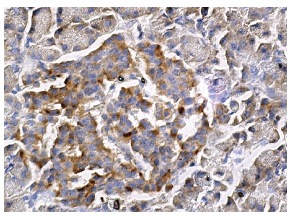
Immunoperoxidase staining of formalin fixed, paraffin-embedded human pancreas tissue showing cytoplasmic staining of Islets of Langerhans and glandular cells.Application
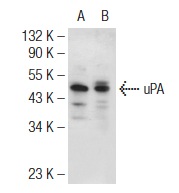
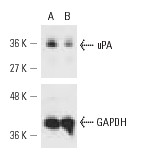
Western blot analysis of uPA expression in MIA PaCa-2 (A) and LNCaP (B) whole cell lysates.Application
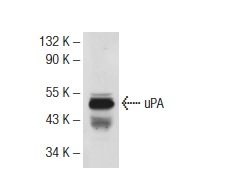
Western blot analysis of uPA expression in MCF7 whole cell lysate.Application
Western blot analysis of uPA expression in non-transfected: (A) and human uPA transfected: (B) 293T whole cell lysates.Application
Western blot analysis of uPA expression in non-transfected control (A) and uPA siRNA transfected (B) HeLa cells. Blot probed with uPA (H-140): . GAPDH (FL-335): used as specificity and loading control.Application
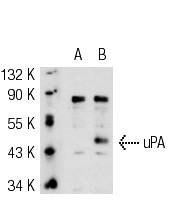
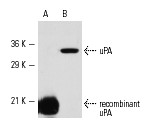
Western blot analysis of human recombinant uPA (A) and uPA expression in Caki-1 whole cell lysate (B).| Product Name | uPA Antibody (H-140) |
|---|---|
| Antibody Type | Primary Antibodies |
| Antigen Alias | epitope corresponding to amino acids 136-275 mapping to an internal region of uPA of human origin |
| Modification Notes | uPA (urokinase-type plasminogen activator) and tPA (tissue plasminogen activator), which are serine proteases and members of the trypsin family, are essential to the intrinsic coagulation system. tPA is primarily involved in fibrinolysis, whereas uPA principally mediates cell migration and tissue remodeling processes. uPA and tPA are responsible for cleaving plasminogen, a large serum ∫-globulin that is deposited on the Fibrin strands within a thrombus. uPA and tPA preferentially target plasminogen at the Arg-Val bond to produce plasmin (also designated fibrinolysin), which is a trypsin-like enzyme that acts on Arg-Lys bonds in Fibrin and Fibrinogen and contributes to the systematic activation of the coagulation cascade. uPA and tPA each consist of two chains that are designated A and B. The A chain of uPA can be cleaved, resulting in low and high molecular mass forms. uPA and tPA are regulated by the serpin family members PAI-1 and PAI-2, which are serine proteinase inhibitors that complex with uPA, tPA and other targeted proteinases and then slowly disassociate to produce cleaved species that fold into stable inactive conformations. |
| Clonality | Polyclonal |
|---|---|
| Isotype | IgG |
| Host Species | Rabbit |
| Tested Applications | WBIPIFIHCELISA |
| recommended for detection of all forms of uPA of mouse, rat and human origin by WB, IP, IF, IHC(P) and ELISA also reactive with additional species, including equine: |
|
| Species Reactivity | HumanMouseRat |
| Concentration | 1mg/ml |
| Purification | Affinity purified |
| Alternative Names | epitope corresponding to amino acids 136-275 mapping to an internal region of uPA of human origin |
|---|---|
| Tissue Specificity | epitope corresponding to amino acids 136-275 mapping to an internal region of uPA of human origin |
| Entrez Gene | 5328 |
|---|
Application
Immunoperoxidase staining of formalin fixed, paraffin-embedded human pancreas tissue showing cytoplasmic staining of Islets of Langerhans and glandular cells.
Application
Western blot analysis of uPA expression in MIA PaCa-2 (A) and LNCaP (B) whole cell lysates.
Application
Western blot analysis of uPA expression in MCF7 whole cell lysate.
Application
Western blot analysis of uPA expression in non-transfected: (A) and human uPA transfected: (B) 293T whole cell lysates.
Application
Western blot analysis of uPA expression in non-transfected control (A) and uPA siRNA transfected (B) HeLa cells. Blot probed with uPA (H-140): . GAPDH (FL-335): used as specificity and loading control.
Application
Western blot analysis of human recombinant uPA (A) and uPA expression in Caki-1 whole cell lysate (B).| Application Notes | recommended for detection of all forms of uPA of mouse, rat and human origin by WB, IP, IF, IHC(P) and ELISA also reactive with additional species, including equine: |
|---|
| Form | Liquid |
|---|---|
| Storage Instructions | For short-term storage, store at 4° C. For long-term storage, aliquot and store at -20ºC or below. Avoid multiple freeze-thaw cycles. |
| Storage Buffer | phosphate buffered saline , pH 7.4, 150mM NaCl, 0.02% sodium azide and 50% glycerol. |


