Application
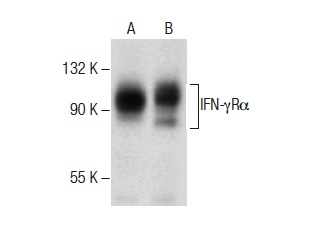
Western blot analysis of IFN-R expression in Raji (A) and AML-193 (B) whole cell lysates.| Product Name | IFN-γRα Antibody (H-300) |
|---|---|
| Antibody Type | Primary Antibodies |
| Antigen Alias | epitope corresponding to amino acids 190-489 mapping at the C-terminus of IFN-γRα of human origin |
| Modification Notes | IFN-gamma induces a variety of biological responses, such as antiviral, antiproliferative and immunomodulatory activity in sensitive cells. Activation of the IFN-gamma receptor (IFN-gammaR) leads to autophosphorylation of the Janus kinases JAK1 and JAK2, and the nuclear translocation of the transcription factors Stat1alpha p91 and Stat1β p84. The IFN-gammaR is composed of at least two chains, designated IFN-gammaRalpha and IFN-gammaRbeta, respectively. Although expression of IFN-gammaRalpha is sufficient for ligand binding, it alone does not confer responsiveness to IFN-gamma. Concomitant expression of IFN-gammaRalpha and IFN-gammaRbeta is required for transcriptional activation of IFN-gamma-inducible genes. The IFN-gammaRbeta chain, also called AF-1, is 332 and 337 amino acids in length in mouse and human, respectively, and may represent the signal transducing component of the IFN-gammaR. |
| Clonality | Polyclonal |
|---|---|
| Isotype | IgG |
| Host Species | Rabbit |
| Tested Applications | WBIPIFELISA |
| recommended for detection of IFN-γRα of human origin by WB, IP, IF and ELISA: |
|
| Species Reactivity | HumanMouseRat |
| Concentration | 1mg/ml |
| Purification | Affinity purified |
| Alternative Names | epitope corresponding to amino acids 190-489 mapping at the C-terminus of IFN-&gamma R&alpha of human origin |
|---|---|
| Tissue Specificity | epitope corresponding to amino acids 190-489 mapping at the C-terminus of IFN-γRα of human origin |
| Entrez Gene | 3459 |
|---|
Application
Western blot analysis of IFN-R expression in Raji (A) and AML-193 (B) whole cell lysates.| Application Notes | recommended for detection of IFN-γRα of human origin by WB, IP, IF and ELISA: |
|---|
| Form | Liquid |
|---|---|
| Storage Instructions | For short-term storage, store at 4° C. For long-term storage, aliquot and store at -20ºC or below. Avoid multiple freeze-thaw cycles. |
| Storage Buffer | phosphate buffered saline , pH 7.4, 150mM NaCl, 0.02% sodium azide and 50% glycerol. |


