Application
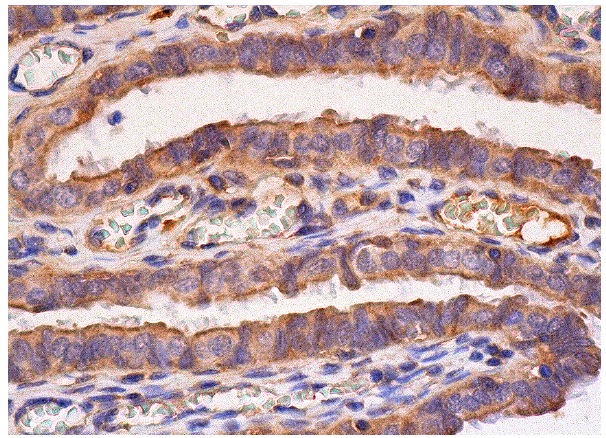
Immunoperoxidase staining of formalin fixed, paraffin-embedded human fallopian tube tissue showing cytoplasmic staining of glandular cells.| Product Name | pki α Antibody (H-55) |
|---|---|
| Antibody Type | Primary Antibodies |
| Antigen Alias | epitope corresponding to amino acids 22-76 mapping at the C-terminus of pki α of human origin |
| Modification Notes | The second messenger cyclic AMP (cAMP) mediates a diverse array of cellular responses such as proliferation, ion transport, regulation of metabolism and gene transcription by activating the cAMP-dependent protein kinase (cAPK or PKA). Activation of PKA occurs when cAMP binds to the two regulatory subunits of tetrameric PKA, resulting in the release of two active catalytic subunits. Two forms of a specific PKA inhibitor molecule, designated pki å and pki ∫, have been described and are suggested to regulate PKA activity in different portions of the central nervous system. For instance, pki å is ex-pressed abundantly in the adult mouse brain, particularly in the cerebellum, hypothalamus, hippocampus and cortex. In constrast, pki ∫ is present at a much lower level in most brain regions, and is found in significant amounts only in the cerebellum and in a few distinct nuclei within the pons, medulla and hypothalamus. |
| Clonality | Polyclonal |
|---|---|
| Isotype | IgG |
| Host Species | Rabbit |
| Tested Applications | WBIPIFIHCELISA |
| recommended for detection of pki α of mouse, rat and human origin by WB, IP, IF, IHC(P) and ELISA also reactive with additional species, including equine, canine, bovine and porcine: |
|
| Species Reactivity | HumanMouseRat |
| Concentration | 1mg/ml |
| Purification | Affinity purified |
| Alternative Names | epitope corresponding to amino acids 22-76 mapping at the C-terminus of pki &alpha of human origin |
|---|---|
| Tissue Specificity | epitope corresponding to amino acids 22-76 mapping at the C-terminus of pki α of human origin |
| Entrez Gene | 5569 |
|---|
Application
Immunoperoxidase staining of formalin fixed, paraffin-embedded human fallopian tube tissue showing cytoplasmic staining of glandular cells.| Application Notes | recommended for detection of pki α of mouse, rat and human origin by WB, IP, IF, IHC(P) and ELISA also reactive with additional species, including equine, canine, bovine and porcine: |
|---|
| Form | Liquid |
|---|---|
| Storage Instructions | For short-term storage, store at 4° C. For long-term storage, aliquot and store at -20ºC or below. Avoid multiple freeze-thaw cycles. |
| Storage Buffer | phosphate buffered saline , pH 7.4, 150mM NaCl, 0.02% sodium azide and 50% glycerol. |


