Application
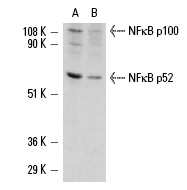
Western blot analysis of NFκB p100 and NFκB p52 expression in Jurkat (A) and K-562 (B) whole cell lysates.| Product Name | NFκB p52 Antibody (447) |
|---|---|
| Antibody Type | Primary Antibodies |
| Antigen Alias | epitope corresponding to amino acids 1-447 representing full length NFκB p52 of human origin |
| Modification Notes | The NFkB transcription factor was originally identi-fied as a protein complex consisting of a DNA binding subunit and an associated protein. The DNA binding subunit is functionally related to c-Rel p75 and Rel B p68. The p50 subunit was initially believed to be a functionally unique protein derived from the amino terminus of a precursor designated p105. A cDNA was isolated that encodes an alternative DNA binding subunit of NFkB. It is synthesized as a protein that is expressed in a variety of cell types and, like p105, undergoes cleavage to generate its NFkB subunit, in this case a protein designated p52 (previously referred to as p49). In contrast to p50 derived from p105, p52 acts in synergy with p65 to stimulate the HIV enhancer in transiently transfected Jurkat cells. |
| Clonality | Polyclonal |
|---|---|
| Isotype | IgG |
| Host Species | Rabbit |
| Tested Applications | WBIPIFELISAGSChIP |
| recommended for detection of NFκB p52 and p100 of mouse, rat and human origin by WB, IP, IF and ELISA partially cross-reactive with NFkB p50 also reactive with additional species, including equine, canine and bovine: |
|
| Species Reactivity | HumanMouseRat |
| Concentration | 1mg/ml |
| Purification | Affinity purified |
| Alternative Names | epitope corresponding to amino acids 1-447 representing full length NF&kappa B p52 of human origin |
|---|---|
| Tissue Specificity | epitope corresponding to amino acids 1-447 representing full length NFκB p52 of human origin |
| Entrez Gene | 4791 |
|---|
Application
Western blot analysis of NFκB p100 and NFκB p52 expression in Jurkat (A) and K-562 (B) whole cell lysates.| Application Notes | recommended for detection of NFκB p52 and p100 of mouse, rat and human origin by WB, IP, IF and ELISA partially cross-reactive with NFkB p50 also reactive with additional species, including equine, canine and bovine: |
|---|
| Form | Liquid |
|---|---|
| Storage Instructions | For short-term storage, store at 4° C. For long-term storage, aliquot and store at -20ºC or below. Avoid multiple freeze-thaw cycles. |
| Storage Buffer | phosphate buffered saline , pH 7.4, 150mM NaCl, 0.02% sodium azide and 50% glycerol. |


