Application
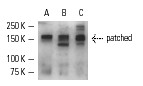
Western blot analysis of patched expression in HeLa whole cell lysate (A), mouse testis (B) and mouse embryo (C) tissue extracts.| Product Name | patched Antibody (H-267) |
|---|---|
| Antibody Type | Primary Antibodies |
| Antigen Alias | epitope corresponding to amino acids 1181-1447 of patched of human origin |
| Modification Notes | Overexpression of either Wnt-1 or the GLI proteins have been shown to result in cancer. These proteins exist in a signal cascade downstream of the mammalian homologs of the Drosophila hedgehog (hh) and patched (ptc) proteins. The hedgehog protein mediates embryonic and imaginal disc patterning, and patched expression is precisely regulated during embryonic development. Hedgehog enhances the expression of the Wnt family of proteins through a signaling cascade involving the GLI transcription factors, while patched functions as a repressor opposing the effects of hedgehog. Mutations in the ptc gene, which result in unregulated hedgehog signaling, correlates with the most common type of cancer, basal cell carcinoma, which affects 750,000 individuals annually in the United States. An additional patched family member, patched 2, has been found to be coexpressed with Sonic hedgehog. |
| Clonality | Polyclonal |
|---|---|
| Isotype | IgG |
| Host Species | Rabbit |
| Tested Applications | WBIPIFELISA |
| recommended for detection of patched of mouse, rat and human origin by WB, IP, IF and ELISA also reactive with additional species, including equine, bovine and porcine: |
|
| Species Reactivity | HumanMouseRat |
| Concentration | 1mg/ml |
| Purification | Affinity purified |
| Alternative Names | epitope corresponding to amino acids 1181-1447 of patched of human origin |
|---|---|
| Tissue Specificity | epitope corresponding to amino acids 1181-1447 of patched of human origin |
| Entrez Gene | 5727 |
|---|
Application
Western blot analysis of patched expression in HeLa whole cell lysate (A), mouse testis (B) and mouse embryo (C) tissue extracts.| Application Notes | recommended for detection of patched of mouse, rat and human origin by WB, IP, IF and ELISA also reactive with additional species, including equine, bovine and porcine: |
|---|
| Form | Liquid |
|---|---|
| Storage Instructions | For short-term storage, store at 4° C. For long-term storage, aliquot and store at -20ºC or below. Avoid multiple freeze-thaw cycles. |
| Storage Buffer | phosphate buffered saline , pH 7.4, 150mM NaCl, 0.02% sodium azide and 50% glycerol. |


