Application
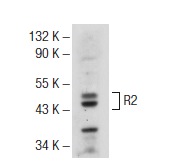
Western blot analysis of R2 expression in SW480 whole cell lysate.| Product Name | R2 Antibody (H-300) |
|---|---|
| Antibody Type | Primary Antibodies |
| Antigen Alias | epitope corresponding to amino acids 90-389 mapping at the C-terminus of R2 of human origin |
| Modification Notes | Ribonucleotide reductase is essential for the production and maintenance of the level of deoxyribonucleoside triphosphates (dNTPs) required for DNA synthesis. It is an enzymatic complex consisting of two nonidentical subunits, R1 and R2, which are inactive separately. R2, the smaller subunit, is localized to the cytoplasm. R2 is the limiting factor of the catalytic activity of the ribonucleotide reductase enzymatic complex. R2 expression is strictly correlated to the S-phase of the cell cycle, whereas R1 remains constant throughout all phases of the cell cycle. While R2 seems to be involved solely in the maintenance of dNTPs for DNA replication, a similar protein, p53R2, has been shown to be responsible for the production of dNTPs in response to DNA damage. |
| Clonality | Polyclonal |
|---|---|
| Isotype | IgG |
| Host Species | Rabbit |
| Tested Applications | WBIPIFELISA |
| recommended for detection of R2 and p53R2 of mouse, rat and human origin by WB, IP, IF and ELISA also reactive with additional species, including equine, canine, bovine, porcine and avian: |
|
| Species Reactivity | HumanMouseRat |
| Concentration | 1mg/ml |
| Purification | Affinity purified |
| Alternative Names | epitope corresponding to amino acids 90-389 mapping at the C-terminus of R2 of human origin |
|---|---|
| Tissue Specificity | epitope corresponding to amino acids 90-389 mapping at the C-terminus of R2 of human origin |
| Entrez Gene | 6241 |
|---|
Application
Western blot analysis of R2 expression in SW480 whole cell lysate.| Application Notes | recommended for detection of R2 and p53R2 of mouse, rat and human origin by WB, IP, IF and ELISA also reactive with additional species, including equine, canine, bovine, porcine and avian: |
|---|
| Form | Liquid |
|---|---|
| Storage Instructions | For short-term storage, store at 4° C. For long-term storage, aliquot and store at -20ºC or below. Avoid multiple freeze-thaw cycles. |
| Storage Buffer | phosphate buffered saline , pH 7.4, 150mM NaCl, 0.02% sodium azide and 50% glycerol. |


