Application
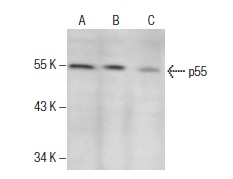
Western blot analysis of p55 expression in K-562 (A), MOLT-4 (B) and HL-60 (C) whole cell lysates.| Product Name | p55 Antibody (H-57) |
|---|---|
| Antibody Type | Primary Antibodies |
| Antigen Alias | epitope corresponding to amino acids 320-376 mapping within an internal region of erythrocyte membrane protein p55 of human origin |
| Modification Notes | P55 is an extensively palmitoylated erythrocyte membrane protein, and a member of the MAGUK family. P55 also resists salt extraction, resulting in a high affinity for the plasma membrane. P55 contains a PDZ/DHR domain, a conserved SH-3 domain that appears to suppress tyrosine kinase activity of various oncoproteins, a 39-amino acid motif that binds to cytoskeletal protein 4.1R, and a guanylate kinase-like domain. Interaction with glycophorin C (GPC) and 4.1R suggests that p55 may play a role in the dynamic regulation in the erythrocyte membrane. In addition, p55 gene expression in vivo may be associated with a CpG island. P55 is constitutively expressed in K562 erythroleukemia cells during erythropoiesis and undergoes a 2-fold amplification after induction. |
| Clonality | Polyclonal |
|---|---|
| Isotype | IgG |
| Host Species | Rabbit |
| Tested Applications | WBIPIFELISA |
| recommended for detection of erythrocyte membrane protein p55 of mouse, rat and human origin by WB, IP, IF and ELISA also reactive with additional species, including equine, canine, bovine and porcine: |
|
| Species Reactivity | HumanMouseRat |
| Concentration | 1mg/ml |
| Purification | Affinity purified |
| Alternative Names | epitope corresponding to amino acids 320-376 mapping within an internal region of erythrocyte membrane protein p55 of human origin |
|---|---|
| Tissue Specificity | epitope corresponding to amino acids 320-376 mapping within an internal region of erythrocyte membrane protein p55 of human origin |
| Entrez Gene | 4354 |
|---|
Application
Western blot analysis of p55 expression in K-562 (A), MOLT-4 (B) and HL-60 (C) whole cell lysates.| Application Notes | recommended for detection of erythrocyte membrane protein p55 of mouse, rat and human origin by WB, IP, IF and ELISA also reactive with additional species, including equine, canine, bovine and porcine: |
|---|
| Form | Liquid |
|---|---|
| Storage Instructions | For short-term storage, store at 4° C. For long-term storage, aliquot and store at -20ºC or below. Avoid multiple freeze-thaw cycles. |
| Storage Buffer | phosphate buffered saline , pH 7.4, 150mM NaCl, 0.02% sodium azide and 50% glycerol. |


