
Application
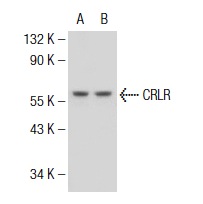
Western blot analysis of CRLR expression in TE671 (A) and A549 (B) whole cell lysates.Application
Western blot analysis of CRLR expression in mouse heart tissue extract.| Product Name | CRLR Antibody (H-42) |
|---|---|
| Antibody Type | Primary Antibodies |
| Modification Notes | Adrenomedullin (ADM) is a hypotensive peptide that belongs to a peptide superfamily, which includes the Calcitonin gene-related peptide (CGRP), a potent vasodilator, and amylin (1,2). Three distinct receptors have the ability to bind ADM and are designated ADM receptor (also designated L1), RDC-1 and calcitonin receptor-like receptor (CRLR) (3). CRLR associates with receptor activity-modifying proteins (RAMPs), which determine the specificity of CRLR binding (2). Co-expression with RAMP1 results in CRLR binding to CGRP, whereas association with RAMP2 or RAMP3 results in ADM binding (2). These RAMP proteins mediate the level of glycosylation of CRLR, which in turn, determines the specificity of the receptors. (4) CRLR is expressed in heart and blood vessels, which suggests its involvement in vasodilation, smooth muscle relaxation and angiogenesis (5,6). RDC-1 is also expressed in heart as well as lung and primarily binds CGRP (6,7). |
| Clonality | Polyclonal |
|---|---|
| Isotype | IgG |
| Host Species | Rabbit |
| Tested Applications | WBIPIFELISA |
| recommended for detection of CRLR of mouse, rat and human origin by WB, IP, IF and ELISA | |
| Species Reactivity | HumanMouseRat |
| Concentration | 1mg/ml |
| Purification | Affinity purified |
| Alternative Names | epitope corresponding to amino acids 23-64 mapping within an N-terminal extracellular domain of CRLR of human origin |
|---|---|
| Tissue Specificity | epitope corresponding to amino acids 23-64 mapping within an N-terminal extracellular domain of CRLR of human origin |
| Entrez Gene | 10203 |
|---|
Application
Western blot analysis of CRLR expression in TE671 (A) and A549 (B) whole cell lysates.
Application
Western blot analysis of CRLR expression in mouse heart tissue extract.| Application Notes | recommended for detection of CRLR of mouse, rat and human origin by WB, IP, IF and ELISA |
|---|
| Form | Liquid |
|---|---|
| Storage Instructions | For short-term storage, store at 4° C. For long-term storage, aliquot and store at -20ºC or below. Avoid multiple freeze-thaw cycles. |
| Storage Buffer | phosphate buffered saline , pH 7.4, 150mM NaCl, 0.02% sodium azide and 50% glycerol. |


