Application
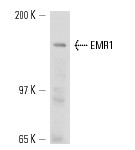
Western blot analysis of EMR1 expression in HeLa whole cell lysate.| Product Name | EMR1 Antibody (H-290) |
|---|---|
| Antibody Type | Primary Antibodies |
| Modification Notes | The epidermal growth factor (EGF)-TM7 family constitutes a group of class B G-protein coupled receptors, which includes CD97, EMR1 (EGF-like molecule containing mucin-like hormone receptor 1, designated F4/80 in mouse), EMR2, EMR3, FIRE, and ETL (1–3). These family members are characterized by an extended extracellular region with several N-terminal EGF domains, and are predominantly expressed on cells of the immune system (1–3). The EGF-TM7 protein family are encoded by a gene cluster on human chromosome 19p13 (1,3,4). The F4/80 molecule is solely expressed on the surface of macrophages and serves as a marker for mature macrophage tissues, including Kupffer cells in liver, splenic red pulp macrophages, brain microglia, gut lamina propria, and Langerhans cells in the skin (1). F4/80/EMR1 undergoes extensive N-linked glycosylation as well as some O-linked glycosylation (5,6). The function of F4/80/EMR1 is unclear, but it is speculated to be involved in macrophage adhesion events, cell migration, or as a G-protein coupled signaling component of macrophages (1). |
| Clonality | Polyclonal |
|---|---|
| Isotype | IgG |
| Host Species | Rabbit |
| Tested Applications | WBIPIFELISA |
| recommended for detection of EMR1 of human origin by WB, IP, IF and ELISA | |
| Species Reactivity | HumanMouseRat |
| Concentration | 1mg/ml |
| Purification | Affinity purified |
| Alternative Names | epitope corresponding to amino acids 241-530 mapping within an extracellular domain of EMR1 of human origin |
|---|---|
| Tissue Specificity | epitope corresponding to amino acids 241-530 mapping within an extracellular domain of EMR1 of human origin |
| Entrez Gene | 2015 |
|---|
Application
Western blot analysis of EMR1 expression in HeLa whole cell lysate.| Application Notes | recommended for detection of EMR1 of human origin by WB, IP, IF and ELISA |
|---|
| Form | Liquid |
|---|---|
| Storage Instructions | For short-term storage, store at 4° C. For long-term storage, aliquot and store at -20ºC or below. Avoid multiple freeze-thaw cycles. |
| Storage Buffer | phosphate buffered saline , pH 7.4, 150mM NaCl, 0.02% sodium azide and 50% glycerol. |


