Application
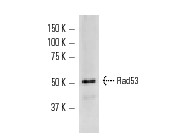
Western blot analysis of yeast recombinant Rad53 fusion protein.| Product Name | Rad53 Antibody (y-300) |
|---|---|
| Antibody Type | Primary Antibodies |
| Antigen Alias | epitope corresponding to amino acids 1-300 mapping at the N-terminus of Rad53 of Saccharomyces cerevisiae origin |
| Modification Notes | DNA damage results in the arrest of cell cycle progression, allowing the damaged DNA to be repaired prior to replication. Checkpoints exist at several cell cycle phase transitions to maintain this genetic integrity. Rad9, Rad17, Rad24 and Mec3 are involved in activating the G1 and G2 checkpoints (1–4). Pol2 (also known as Dun2), encoding the catalytic subunit of DNA polymerase epsilon, plays a role in activating the S phase checkpoint (5). The protein kinase Rad53 (also designated Spk1, Mec2 or Sad1) is essential for both G2 and S phase arrest. Activation of Rad53 is regulated by Mec1 (also known as Esr1 and Sad3), a homolog of the human ATM protein (6). Pds1 and Mad2 both regulate checkpoints associated with incomplete spindle replication (7,8). Dun1, another protein kinase, plays a role in transducing the DNA damage signal (9). |
| Clonality | Polyclonal |
|---|---|
| Isotype | IgG |
| Host Species | Rabbit |
| Tested Applications | WBIPELISA |
| recommended for detection of Rad53 of Saccharomyces cerevisiae origin by WB, IP and ELISA: |
|
| Species Reactivity | HumanMouseRat |
| Concentration | 1mg/ml |
| Purification | Affinity purified |
| Alternative Names | epitope corresponding to amino acids 1-300 mapping at the N-terminus of Rad53 of Saccharomyces cerevisiae origin |
|---|---|
| Tissue Specificity | epitope corresponding to amino acids 1-300 mapping at the N-terminus of Rad53 of Saccharomyces cerevisiae origin |
Application
Western blot analysis of yeast recombinant Rad53 fusion protein.| Application Notes | recommended for detection of Rad53 of Saccharomyces cerevisiae origin by WB, IP and ELISA: |
|---|
| Form | Liquid |
|---|---|
| Storage Instructions | For short-term storage, store at 4° C. For long-term storage, aliquot and store at -20ºC or below. Avoid multiple freeze-thaw cycles. |
| Storage Buffer | phosphate buffered saline , pH 7.4, 150mM NaCl, 0.02% sodium azide and 50% glycerol. |


