Application
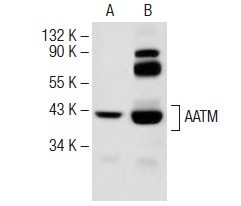
Western blot analysis of AATM expression in Hep G2 whole cell lysate (A) and mouse heart tissue extract (B).| Product Name | AATM Antibody (H-71) |
|---|---|
| Antibody Type | Primary Antibodies |
| Antigen Alias | epitope corresponding to amino acids 141-211 mapping within an internal region of AATM of human origin |
| Modification Notes | Aspartate aminotransferase (AAT) is an ubiquitous pyridoxal phosphate-dependent enzyme, which exists in both mitochondrial (AATM) and cytosolic (AATC) forms. The enzyme plays an important role in amino acid metabolism and in the urea and tricarboxylic acid cycles by catalyzing the conversion of L-aspartate and 2-oxoglutarate to oxaloacetate and L-glutamate. The two isoenzymes are homodimeric, but differ in expression patterns. Approximately 80% of the enzyme activity in liver is of mitochondrial origin, whereas in serum the enzyme activity is largely cytosolic. AATC and AATM share nearly identical three-dimensional structures, but differ in their folding rates and in their affinity for binding to molecular chaperones, including GroEL. |
| Clonality | Polyclonal |
|---|---|
| Isotype | IgG |
| Host Species | Rabbit |
| Tested Applications | WBIPIFELISA |
| recommended for detection of aspartate aminotransferase mitochondrial form of mouse, rat and human origin by WB, IP, IF and ELISA also reactive with additional species, including equine, canine, bovine and porcine: |
|
| Species Reactivity | HumanMouseRat |
| Concentration | 1mg/ml |
| Purification | Affinity purified |
| Alternative Names | epitope corresponding to amino acids 141-211 mapping within an internal region of AATM of human origin |
|---|---|
| Tissue Specificity | epitope corresponding to amino acids 141-211 mapping within an internal region of AATM of human origin |
Application
Western blot analysis of AATM expression in Hep G2 whole cell lysate (A) and mouse heart tissue extract (B).| Application Notes | recommended for detection of aspartate aminotransferase mitochondrial form of mouse, rat and human origin by WB, IP, IF and ELISA also reactive with additional species, including equine, canine, bovine and porcine: |
|---|
| Form | Liquid |
|---|---|
| Storage Instructions | For short-term storage, store at 4° C. For long-term storage, aliquot and store at -20ºC or below. Avoid multiple freeze-thaw cycles. |
| Storage Buffer | phosphate buffered saline , pH 7.4, 150mM NaCl, 0.02% sodium azide and 50% glycerol. |


