Application
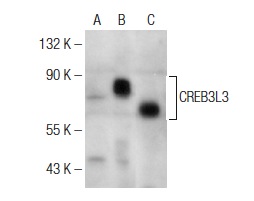
Western blot analysis of CREB3L3 expression in non-transfected: (A) and human CREB3L3 transfected: (B) 293T whole cell lysates and mouse liver tissue extract (C).| Product Name | CREB3L3 Antibody (H-148) |
|---|---|
| Antibody Type | Primary Antibodies |
| Antigen Alias | epitope corresponding to amino acids 90-237 mapping within an internal region of CREB3L3 of human origin |
| Modification Notes | CREB3L3 (cAMP-responsive element-binding protein 3-like protein 3), also known as CREBH or HYST1481, is a 461 amino acid single-pass type II membrane protein that localizes to the endoplasmic reticulum (ER) and, in response to ER stress, is cleaved and translocated to the nucleus. Expressed exclusively in liver, CREB3L3 functions as a transcription factor that, during ER stress, is thought to activate genes that are involved in both the unfolded protein response and the acute phase response (APR). Additionally, CREB3L3 is underexpressed in hepatocellular carcinoma, suggesting a possible role as a tumor suppressor. CREB3L3 functions as a dimer and contains one leucine zipper domain, a KDEL-like sequence and a bZIP domain, through which it conveys its DNA binding ability. Three isoforms of CREB3L3 exist due to alternative splicing events. |
| Clonality | Polyclonal |
|---|---|
| Isotype | IgG |
| Host Species | Rabbit |
| Tested Applications | WBIPIFELISA |
| recommended for detection of CREB3L3 of mouse and human origin by WB, IP, IF and ELISA: |
|
| Species Reactivity | HumanMouseRat |
| Concentration | 1mg/ml |
| Purification | Affinity purified |
| Alternative Names | epitope corresponding to amino acids 90-237 mapping within an internal region of CREB3L3 of human origin |
|---|---|
| Tissue Specificity | epitope corresponding to amino acids 90-237 mapping within an internal region of CREB3L3 of human origin |
| Entrez Gene | 84699 |
|---|
Application
Western blot analysis of CREB3L3 expression in non-transfected: (A) and human CREB3L3 transfected: (B) 293T whole cell lysates and mouse liver tissue extract (C).| Application Notes | recommended for detection of CREB3L3 of mouse and human origin by WB, IP, IF and ELISA: |
|---|
| Form | Liquid |
|---|---|
| Storage Instructions | For short-term storage, store at 4° C. For long-term storage, aliquot and store at -20ºC or below. Avoid multiple freeze-thaw cycles. |
| Storage Buffer | phosphate buffered saline , pH 7.4, 150mM NaCl, 0.02% sodium azide and 50% glycerol. |


