Application
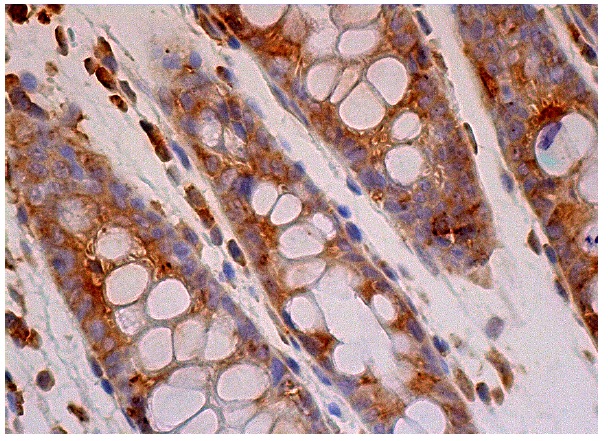
Immunoperoxidase staining of formalin fixed, paraffin-embedded human colon tissue showing cytoplasmic staining of glandular cells.| Product Name | AHRR Antibody (D-14) |
|---|---|
| Antibody Type | Primary Antibodies |
| Modification Notes | AHRR (aryl-hydrocarbon receptor repressor), also known as bHLHe77 (class E basic helix-loop-helix protein 77), is a 701 amino acid protein. Encoded by a gene that maps to human chromosome 5p15.33, AHRR exists as three alternatively spliced isoforms. AHRR localizes initially in cytoplasm, interacts with Arnt 1 and translocates to nucleus for prominent localization. Containing one basic helix-loop-helix (bHLH) domain and one PAS (PER-ARNT-SIM) domain, AHRR is highly expressed in testis, lung, ovary, spleen, pancreas, kidney and thymus. AHRR is also highly expressed in mononuclear cells from umbilical cord blood and autoregulates its expression by associating with its own xenobiotic response element (XRE) site. AHRR regulates dioxin toxicity and participates in cell growth regulation and differentiation. Suppressing transcription activity of Ah Receptor, AHRR competes with the transcription factor for heterodimer formation with Arnt 1, and subsequently binds to the XRE sequence in the promoter. AHRR also suppresses CYP1A1 by binding the XRE sequence and recruiting ANKRA, HDAC4 or HDAC5. AHRR may be linked to male infertility and endometriosis susceptibilty. |
| Clonality | Polyclonal |
|---|---|
| Isotype | IgG |
| Host Species | Rabbit |
| Tested Applications | WBIFIHCELISA |
| recommended for detection of AHRR of mouse, rat and human origin by WB, IF, IHC(P) and ELISA also reactive with additional species, including equine, canine, porcine and avian | |
| Species Reactivity | HumanMouseRat |
| Concentration | 1mg/ml |
| Purification | Affinity purified |
| Alternative Names | epitope mapping within an internal region of AHRR of human origin |
|---|---|
| Tissue Specificity | epitope mapping within an internal region of AHRR of human origin |
| Entrez Gene | 57491 |
|---|
Application
Immunoperoxidase staining of formalin fixed, paraffin-embedded human colon tissue showing cytoplasmic staining of glandular cells.| Application Notes | recommended for detection of AHRR of mouse, rat and human origin by WB, IF, IHC(P) and ELISA also reactive with additional species, including equine, canine, porcine and avian |
|---|
| Form | Liquid |
|---|---|
| Storage Instructions | For short-term storage, store at 4° C. For long-term storage, aliquot and store at -20ºC or below. Avoid multiple freeze-thaw cycles. |
| Storage Buffer | phosphate buffered saline , pH 7.4, 150mM NaCl, 0.02% sodium azide and 50% glycerol. |


