Application
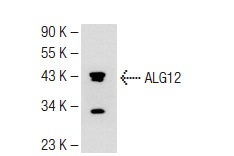
Western blot analysis of ALG12 expression in HeLa whole cell lysate.| Product Name | ALG12 Antibody (T-12) |
|---|---|
| Antibody Type | Primary Antibodies |
| Modification Notes | ALG12 (asparagine-linked glycosylation 12 homolog), also known as ECM39 or membrane protein SB87, is a 488 amino acid member of the glycosyltransferase 22 family that functions as a mannosyltransferase required for proper protein glycosylation. ALG12 is a multi-pass membrane protein that is expressed in fibroblasts and localizes to the endoplasmic reticulum (ER). Specifically, ALG12 catalyzes the addition of å1,6 mannose to dolichol-linked Man7GlcNAc2. Defects in ALG12 disrupt protein N-glycosylation and result in congenital disorder of glycosylation type 1G (CDG1G). CDG1G is a multisystem disease characterized by under-glycosylated serum proteins. N-glycoproteins play important roles in cell maintenance, embryonic development and differentiation. A disease affecting the proper function of these proteins can lead to coagulation disorders, psychomotor retardation, hypotonia, immunodeficiency and dysmorphic features. |
| Clonality | Polyclonal |
|---|---|
| Isotype | IgG |
| Host Species | Rabbit |
| Tested Applications | WBIPIFELISA |
| recommended for detection of ALG12 of mouse and human origin by WB, IP, IF and ELISA non cross-reactive with other ALG family members also reactive with additional species, including equine, canine, bovine, porcine and avian | |
| Species Reactivity | HumanMouseRat |
| Concentration | 1mg/ml |
| Purification | Affinity purified |
| Alternative Names | epitope mapping within an internal region of ALG12 of human origin |
|---|---|
| Tissue Specificity | epitope mapping within an internal region of ALG12 of human origin |
| Entrez Gene | 79087 |
|---|
Application
Western blot analysis of ALG12 expression in HeLa whole cell lysate.| Application Notes | recommended for detection of ALG12 of mouse and human origin by WB, IP, IF and ELISA non cross-reactive with other ALG family members also reactive with additional species, including equine, canine, bovine, porcine and avian |
|---|
| Form | Liquid |
|---|---|
| Storage Instructions | For short-term storage, store at 4° C. For long-term storage, aliquot and store at -20ºC or below. Avoid multiple freeze-thaw cycles. |
| Storage Buffer | phosphate buffered saline , pH 7.4, 150mM NaCl, 0.02% sodium azide and 50% glycerol. |


