Application
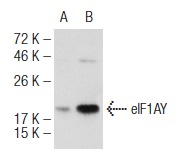
Western blot analysis of eIF1AY expression in non-transfected: (A) and human eIF1AY transfected: (B) 293 whole cell lysates.Application
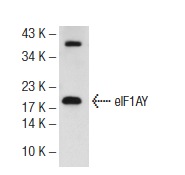
Western blot analysis of eIF1AY expression in 293T whole cell lysate.| Product Name | eIF1AY Antibody (G-17) |
|---|---|
| Antibody Type | Primary Antibodies |
| Modification Notes | Ribosomes, made of Ribonucleoprotein, are the cellular machinery used to catalyze assembly of amino acids into polypeptide chains translated from a template messenger RNA sequence. In eukaryotes, the ribosome consists of a 40S (small) and a 60S (large) subunit. Protein synthesis initiates through the binding of mRNA to the 40S subunit followed by an aminoacylated tRNA and the 60S subunit. The initiating charged tRNA, which base pairs with an AUG start codon on the mRNA, is bound to the essential amino acid methionine (Met). eIF1AY (eukaryotic translation initiation factor 1A, Y-chromosomal), also known as eIF-1A Y isoform and eIF-4C, is a 144 amino acid protein that is ubiquitously expressed and is thought to enhance protein biosynthesis. Ribosomal subunit dissociation and binding of the 40S subunit to Met-tRNA is assisted by eIF1AY. eIF1AY, a cytoplasmic protein, is encoded by a gene in the nonrecombining region of the Y chromosome (NRY) in human and on chromosome 18 in mouse and rat where it is known as eIF1A. eIF-1AX, a related protein known as eIF1AY in mouse, is a 144 amino acid protein encoded by the X chromosome in human, mouse, and rat. eIF1AY and eIF1AX contain a single S1-like domain. |
| Clonality | Polyclonal |
|---|---|
| Isotype | IgG |
| Host Species | Rabbit |
| Tested Applications | WBIPIFELISA |
| recommended for detection of eIF1AY and eIF1AX of human origin and eIF1A of mouse and rat origin by WB, IP, IF and ELISA also reactive with additional species, including equine, canine, bovine, porcine and avian | |
| Species Reactivity | HumanMouseRat |
| Concentration | 1mg/ml |
| Purification | Affinity purified |
| Alternative Names | epitope mapping within an internal region of eIF1AY of human origin |
|---|---|
| Tissue Specificity | epitope mapping within an internal region of eIF1AY of human origin |
Application
Western blot analysis of eIF1AY expression in non-transfected: (A) and human eIF1AY transfected: (B) 293 whole cell lysates.
Application
Western blot analysis of eIF1AY expression in 293T whole cell lysate.| Application Notes | recommended for detection of eIF1AY and eIF1AX of human origin and eIF1A of mouse and rat origin by WB, IP, IF and ELISA also reactive with additional species, including equine, canine, bovine, porcine and avian |
|---|
| Form | Liquid |
|---|---|
| Storage Instructions | For short-term storage, store at 4° C. For long-term storage, aliquot and store at -20ºC or below. Avoid multiple freeze-thaw cycles. |
| Storage Buffer | phosphate buffered saline , pH 7.4, 150mM NaCl, 0.02% sodium azide and 50% glycerol. |


