Application
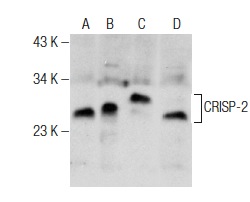
Western blot analysis of CRISP-2 expression in mouse testis (A), human epididymus (B), mouse epididymus (C) and rat testis (D) tissue extracts.| Product Name | CRISP-2 Antibody (H-73) |
|---|---|
| Antibody Type | Primary Antibodies |
| Antigen Alias | epitope corresponding to amino acids 171-243 mapping at the C-terminus of CRISP-2 of human origin |
| Modification Notes | Cysteine-rich secretory proteins (CRISPs) represent a family of evolutionarily conserved proteins which may play a role in the innate immune system and are transcriptionally regulated by androgens in several tissues. CRISP-1 coats the postacrosomal region of sperm heads as they pass through the epididymis. CRISP-1 is found in all regions of the epididymis, ductus deferens, seminal plasma and sperm. CRISP-2, also known as testis-specific protein TPX1 or cancer/testis antigen 36 (CT36), is a 243 amino acid secreted protein. Expressed in the testis and epididymis, CRISP-2 is thought to be involved in calcium fluxes during sperm capacitation by regulating the activity of certain ion channels. CRISP-3 is expressed in pancreas and prostate tissues and, along with CRISP-1, is expressed in saliva. The gene that encodes CRISP-3 is an early response gene that may participate in the pathophysiology of the auto-immune lesions of Sjogren’s syndrome. |
| Clonality | Polyclonal |
|---|---|
| Isotype | IgG |
| Host Species | Rabbit |
| Tested Applications | WBIPIFELISA |
| recommended for detection of CRISP-2 of mouse, rat and human origin by WB, IP, IF and ELISA: |
|
| Species Reactivity | HumanMouseRat |
| Concentration | 1mg/ml |
| Purification | Affinity purified |
| Alternative Names | epitope corresponding to amino acids 171-243 mapping at the C-terminus of CRISP-2 of human origin |
|---|---|
| Tissue Specificity | epitope corresponding to amino acids 171-243 mapping at the C-terminus of CRISP-2 of human origin |
| Entrez Gene | 7180 |
|---|
Application
Western blot analysis of CRISP-2 expression in mouse testis (A), human epididymus (B), mouse epididymus (C) and rat testis (D) tissue extracts.| Application Notes | recommended for detection of CRISP-2 of mouse, rat and human origin by WB, IP, IF and ELISA: |
|---|
| Form | Liquid |
|---|---|
| Storage Instructions | For short-term storage, store at 4° C. For long-term storage, aliquot and store at -20ºC or below. Avoid multiple freeze-thaw cycles. |
| Storage Buffer | phosphate buffered saline , pH 7.4, 150mM NaCl, 0.02% sodium azide and 50% glycerol. |


