Application
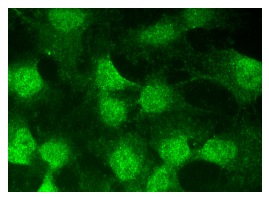
Immunofluorescence staining of formalin-fixed Hep G2 cells showing nuclear and cytoplasmic localization.Application
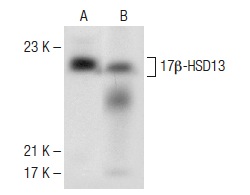
Western blot analysis of 17β-HSD13 expression in Hep G2 whole cell lysate (A) and rat liver tissue extract (B).| Product Name | 17β-HSD13 Antibody (H-40) |
|---|---|
| Antibody Type | Primary Antibodies |
| Modification Notes | 17∫-HSD13 (17∫ hydroxysteroid dehydrogenase type 13), also designated Short-chain dehydrogenase/reductase 9 (SCDR9), belongs to the 17∫-HSD family of proteins, which regulate the availability of steroids within various tissues throughout the body. 17∫-HSD13 is a 300 amino acid secreted protein that is highly expressed in liver and is also detected in ovary, bone marrow, kidney, brain, lung, skeletal muscle, bladder and testis. The gene encoding 17∫-HSD13 maps to chromosome 4, which houses nearly 6% of the human genome and has the largest gene deserts (regions of the genome with no protein encoding genes) of all of the human chromosomes. Defects in some of the genes located on chromosome 4 are associated with Huntington's disease, Ellis-van Creveld syndrome, methylmalonic acidemia and polycystic kidney disease. |
| Clonality | Polyclonal |
|---|---|
| Isotype | IgG |
| Host Species | Rabbit |
| Tested Applications | WBIPIFELISA |
| recommended for detection of 17&beta-HSD13 of human origin by WB, IP, IF and ELISA | |
| Species Reactivity | HumanMouseRat |
| Concentration | 1mg/ml |
| Purification | Affinity purified |
| Alternative Names | epitope corresponding to amino acids 261-300 mapping at the C-terminus of 17&beta HSD13 of human origin |
|---|---|
| Tissue Specificity | epitope corresponding to amino acids 261-300 mapping at the C-terminus of 17βHSD13 of human origin |
Application
Immunofluorescence staining of formalin-fixed Hep G2 cells showing nuclear and cytoplasmic localization.
Application
Western blot analysis of 17β-HSD13 expression in Hep G2 whole cell lysate (A) and rat liver tissue extract (B).| Application Notes | recommended for detection of 17&beta-HSD13 of human origin by WB, IP, IF and ELISA |
|---|
| Form | Liquid |
|---|---|
| Storage Instructions | For short-term storage, store at 4° C. For long-term storage, aliquot and store at -20ºC or below. Avoid multiple freeze-thaw cycles. |
| Storage Buffer | phosphate buffered saline , pH 7.4, 150mM NaCl, 0.02% sodium azide and 50% glycerol. |


