Application
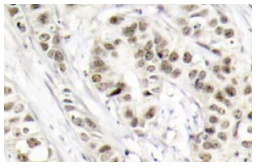
Immunoperoxidase staining of formalin-fixed, paraffin-embedded human breast carcinoma tissue showing cytolasmic staining.| Product Name | p-BRCA1 Antibody (Ser 1524) |
|---|---|
| Antibody Type | Primary Antibodies |
| Antigen Alias | epitope corresponding to phosphorylated Ser 1524 of BRCA1 of human origin |
| Modification | Phosphoralated |
| Modification Notes | In 1990, a breast cancer susceptibility gene, designated BRCA1, was localized to chromosome 17q. Mutations within this gene are believed to account for approximately 45% of families with high incidence of breast cancer and at least 80% of families with increased incidence of both early-onset breast cancer and ovarian cancer. A second breast cancer susceptibility gene, BRCA2, located on chromosome 13q12-13, also confers a high incidence of breast cancer but, unlike BRCA1, does not confer a substantially elevated risk of ovarian cancer. The BRCA1 gene is expressed in numerous tissues, including breast and ovary, and encodes a predicted protein of 1863 amino acids. This protein contains a zinc finger domain in its amino terminal region, but is otherwise unrelated to any previously described proteins. Like many other genes involved in familial cancer, BRCA1 appears to encode a tumor suppressor, a protein that acts as a negative regulator of tumor growth. |
| Clonality | Polyclonal |
|---|---|
| Isotype | IgG |
| Host Species | Rabbit |
| Tested Applications | IFIHC |
| recommended for detection of Ser 1524 phosphorylated BRCA1 of h origin by IF and IHC(P): |
|
| Species Reactivity | HumanMouseRat |
| Concentration | 1mg/ml |
| Purification | Affinity purified |
| Alternative Names | epitope corresponding to phosphorylated Ser 1524 of BRCA1 of human origin |
|---|---|
| Tissue Specificity | epitope corresponding to phosphorylated Ser 1524 of BRCA1 of human origin |
| Entrez Gene | 672 |
|---|
Application
Immunoperoxidase staining of formalin-fixed, paraffin-embedded human breast carcinoma tissue showing cytolasmic staining.| Application Notes | recommended for detection of Ser 1524 phosphorylated BRCA1 of h origin by IF and IHC(P): |
|---|
| Form | Liquid |
|---|---|
| Storage Instructions | For short-term storage, store at 4° C. For long-term storage, aliquot and store at -20ºC or below. Avoid multiple freeze-thaw cycles. |
| Storage Buffer | phosphate buffered saline , pH 7.4, 150mM NaCl, 0.02% sodium azide and 50% glycerol. |


