Application
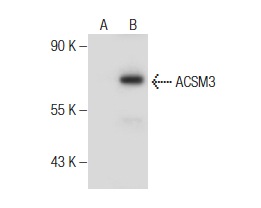
Western blot analysis of ACSM3 expression in non-transfected: (A) and human ACSM3 transfected: (B) 293T whole cell lysates.| Product Name | ACSM3 Antibody (M-50) |
|---|---|
| Antibody Type | Primary Antibodies |
| Modification Notes | The acyl-CoA synthetase medium-chain (ACSM) family is comprised of ACSM1, ACSM2A, ACSM2B, ACSM3, ACSM4 and ACSM5, which encode for enzymes catalyzing the activation of medium-chain length fatty acids. ACSM3 is a 586 amino acid protein has a broad substrate specificity and utilizes magnesium as a cofactor. The gene encoding ACSM3 maps to human chromosome 16, which encodes over 900 genes and comprises nearly 3% of the human genome. The GAN gene is located on chromosome 16 and, with mutation, may lead to giant axonal neuropathy, a nervous system disorder characterized by increasing malfunction with growth. The rare disorder Rubinstein-Taybi syndrome is also associated with chromosome 16, as is Crohn's disease, which is a gastrointestinal inflammatory condition. |
| Clonality | Polyclonal |
|---|---|
| Isotype | IgG |
| Host Species | Rabbit |
| Tested Applications | WBIPIFELISA |
| recommended for detection of ACSM3 of mouse, rat and, to a lesser extent, human origin by WB, IP, IF and ELISA | |
| Species Reactivity | HumanMouseRat |
| Concentration | 1mg/ml |
| Purification | Affinity purified |
| Alternative Names | epitope corresponding to amino acids 1-50 mapping at the N-terminus of ACSM3 of mouse origin |
|---|---|
| Tissue Specificity | epitope corresponding to amino acids 1-50 mapping at the N-terminus of ACSM3 of mouse origin |
Application
Western blot analysis of ACSM3 expression in non-transfected: (A) and human ACSM3 transfected: (B) 293T whole cell lysates.| Application Notes | recommended for detection of ACSM3 of mouse, rat and, to a lesser extent, human origin by WB, IP, IF and ELISA |
|---|
| Form | Liquid |
|---|---|
| Storage Instructions | For short-term storage, store at 4° C. For long-term storage, aliquot and store at -20ºC or below. Avoid multiple freeze-thaw cycles. |
| Storage Buffer | phosphate buffered saline , pH 7.4, 150mM NaCl, 0.02% sodium azide and 50% glycerol. |


